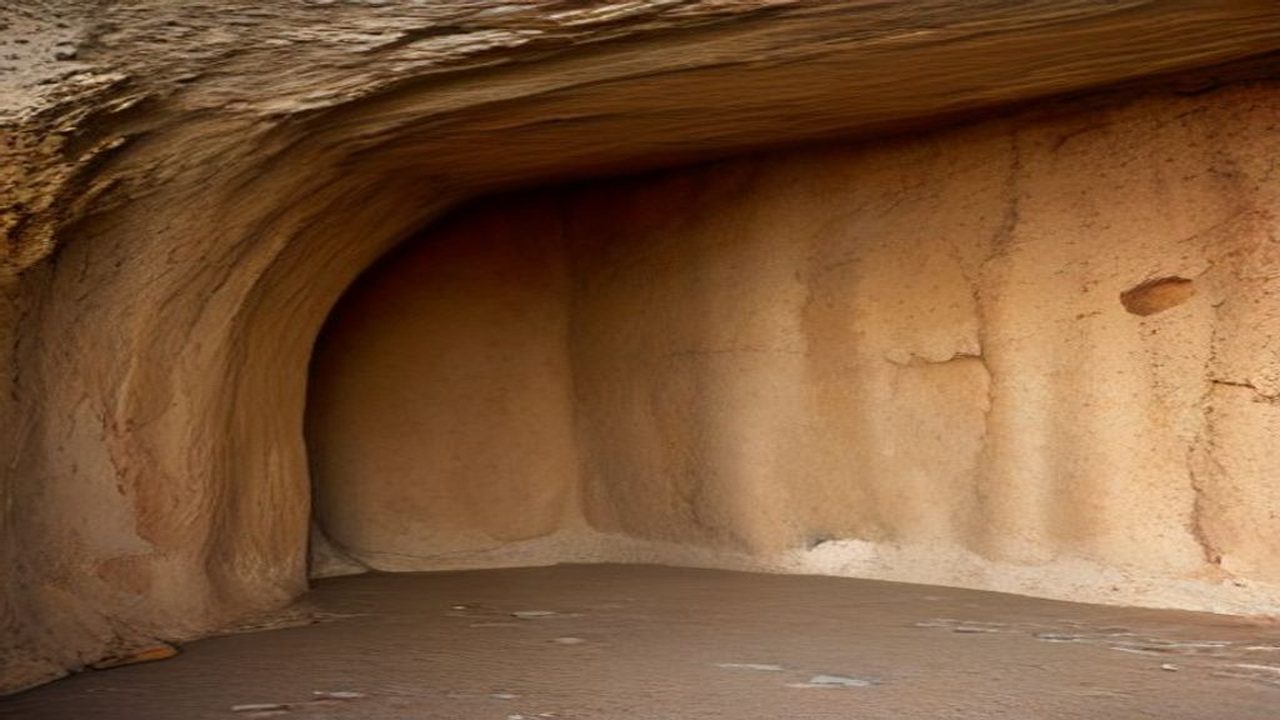
On a wall in the Maltravieso cave, in Extremadura, there is a hand. Someone laid a palm flat against the limestone and blew red pigment around it, so that what survives is not the mark of the hand but the shape of its absence — a negative, printed by contact, life-size. Uranium-thorium dating of the carbonate that later grew over it gives a minimum age of 66,700 years. That is more than twenty thousand years before modern humans are thought to have reached western Europe, which is why the stencil is usually described, cautiously, as Neanderthal.
If you wanted to find the DNA of a prehistoric artist, that hand is where you would start. It is the most intimate thing in the entire repertoire of cave art: not a depiction of a body but a direct impression of one, made by pressing skin to stone. In 2024 and 2025 a team went into Maltravieso and swabbed it.
It gave them nothing.
What the team actually did
The study appeared on 23 June 2026 in Nature Communications, under the flat and honest title "Investigating ancient human DNA preservation on cave walls and in rock art". It runs to thirty-eight authors, led by Alba Bossoms Mesa of the Max Planck Institute for Evolutionary Anthropology in Leipzig with Hipólito Collado Giraldo, and with Matthias Meyer — one of the people who built the field of sediment DNA — as senior author. Museum staff from Altamira, archaeologists from Tomar and Oviedo and Cádiz, and Genevieve von Petzinger, who has spent her career cataloguing the abstract signs that accompany the animals, are all on the paper.
The design was straightforward and the numbers are worth stating plainly, because they are the story. Fifty-four pigment samples were taken from 24 rock art panels across eleven caves in Spain and Portugal, then subdivided into 64 subsamples. Alongside them the team took 66 subsamples from unpigmented wall — bare rock near the art, as a comparison. The panels covered the full range of what Palaeolithic people put on stone: simple marks at nine sites, the hand stencils at Maltravieso, and the polychrome bison of Altamira itself.
The question was as old as the discipline and had never been asked this way: does the art hold the artist?
The trick that separates a person from a bear
The methodological core is elegant, and it is the part worth understanding, because everything else depends on it.
A cave is not a clean room. Air, dust and dripping water carry genetic material everywhere, and the floors of these caves are full of bear, hyena and deer. A wall sample containing human DNA therefore proves very little on its own.
The team's control was faunal DNA. If a sample contains human DNA and animal DNA, that mixture looks like ambient deposition: the surface passively caught what was in the cave. But if human DNA turns up with no animal DNA alongside it, the ambient explanation fails. Something put it there directly — a hand, breath, skin against rock.
The absence of bear DNA is the evidence. What isn't in the sample tells you how what is in it got there.
The second filter is chemical. Ancient DNA degrades in a characteristic way: cytosines deaminate at the ends of the fragments, and the rate of that damage accumulates over time. Fragments without that signature are not old, whatever else they are. This is how the field distinguishes a Palaeolithic trace from the technician who handled the swab.
Altamira's problem is us
Which brings us to the most quietly devastating line in the paper.
At Altamira the team recovered a great deal of human mitochondrial DNA — between 1,050 and 17,122 fragments depending on the sample. An enormous yield. And no significant deamination signal in any of it.
All of it was modern.
The DNA on the ceiling of the most famous painted cave in Europe is our DNA. It belongs to the people who came to look: the excavators, the conservators, the guides, the photographers, the schoolchildren, the scientists, everyone who has filed beneath those bison since Marcelino Sanz de Sautuola's daughter looked up in 1879. Altamira was closed to general visiting in 1977 precisely because human presence — breath, warmth, moisture, microbes — was damaging the pigments. The same century of bodies that endangered the paintings also wrote itself over them in a genetic layer thick enough to swamp anything underneath.
There is an irony here that I think is more than decorative. The caves we care about most, the ones with names, are the ones we have most thoroughly contaminated. Fame is a form of erasure that nobody anticipated.
Escoural, and the one panel that answered
The positive results came from further west and much further from the tour bus.
At the Gruta do Escoural in Portugal, a pigmented calcite crust yielded ancient human mitochondrial and nuclear DNA with no faunal DNA accompanying it — the direct-contact signature. An unpigmented wall sample from the same site did the same. That is one painted panel out of twenty-four: the entire positive rate for rock art in the study.
Three further unpigmented samples, from Escoural and from Covarón in Asturias, produced human and animal DNA mixed together — real, but ambient, the wall acting as a passive collector.
The Covarón material was rich enough for population genetics. Two unpigmented samples carried sufficient nuclear DNA to place their ancestry, and they clustered within the variation of western hunter-gatherers, the group whose known genetic clusters span roughly 16,700 to 5,200 years before present. Dating the wall traces themselves is cruder: deamination rates give a minimum of about 1,000 years for one Covarón sample and about 2,000 for the rest. Minimums, not measurements. The material could be far older; the method simply cannot say how much.
What it does not say
The authors are unusually direct about this, in the abstract itself: their results "do not conclusively link ancient human DNA preservation to the generation of cave art."
Benjamin Smith, a rock art specialist not involved in the work, put the objection to Science News in one sentence: the DNA "was found on the surface in the environs of the rock art, but it might have been left by any person near that rock face, perhaps long after the rock art was made."
That is the whole difficulty, and no refinement of laboratory technique dissolves it. Caves were not galleries. People sheltered in them, slept in them, buried their dead in them, hid in them from weather and from each other, for tens of thousands of years after the last pigment was blown. A hand on a painted wall in 8000 BCE leaves the same trace as a hand on a painted wall in 30,000 BCE. Contact is not authorship.
Why a near-miss is worth this much attention
Here is my own reading, offered as interpretation rather than finding.
Art history has spent a century and a half answering the question who made this by looking: at handling, at habit, at the unguarded detail. That method has been extraordinarily productive and it is entirely circumstantial. What ancient DNA proposes is an answer that does not pass through the eye at all — not whose hand does this resemble but whose cells are these.
It is the same shift I described when machines began issuing percentages about Caravaggio, and it runs into the same wall. The technique produces a trace; a trace is not a verdict; and the distance between the two is filled, as always, by argument.
What the method actually buys is more valuable than the headline it did not earn. A great many painted caves contain no burials, no skeletons, no occupation deposits — nothing to sequence and nothing to excavate. If walls hold DNA at all, then a surface that was previously mute becomes a source, and it can be read without disturbing anything. That is a genuine addition to the evidence base, of the same order as the imaging that revealed a soldier under two centuries of overpaint in a de Hooch, or the image search that turned up a medieval panel nobody was hunting for. New instruments do not usually settle old questions. They change what counts as evidence, and the questions get re-argued on the new ground — which is why the documentary chain behind an object keeps mattering however good the laboratory becomes — and why, when a stolen Cézanne turns up five months later still unsold, it is the paperwork rather than the picture that did the work.
Honest limits
Four cautions, in the spirit of a paper that was careful about its own.
Preservation is rare and capricious. Five informative results out of roughly 130 subsamples, and one panel out of twenty-four. Meyer's own summary is that preservation on cave walls is highly variable. Anyone designing a survey on the strength of this should budget for nulls.
The ages are floors. "At least 2,000 years" is compatible with 2,400 and with 24,000. It is a lower bound produced by a damage clock, not a date.
Contamination inverts the usual priorities. The Altamira result implies that the best candidates for this method are the least visited and least studied caves — precisely the ones art history has paid least attention to.
And the ceiling is low even in the best case. A flawless result identifies a person who touched a wall. It does not identify a painter. Whether that gap can ever be closed is, at present, an open question, and the authors do not pretend otherwise.
So the hand at Maltravieso keeps its secret, and I find I do not mind. It was always the better witness. A genome would have told us about a population — its ancestry, its migrations, its cousins. The stencil tells us that a particular body, with a hand of that exact size, went into the dark, chose that patch of wall, filled its mouth with pigment, and wanted the shape of itself to stay there. Sixty-six thousand years later the only thing that has failed to survive is the part we thought we could measure.
Frequently asked questions
Did scientists find the DNA of the cave painters? No. Ancient human DNA was recovered from cave walls, including one pigmented surface at Escoural, but the authors state that the results do not conclusively link that DNA to the making of the art. A wall collects traces from everyone who touches it, including people who arrived millennia after the paintings.
Which caves gave results? Escoural in Portugal produced the only positive from a painted surface, with mitochondrial and nuclear DNA and no animal DNA alongside it. Unpigmented samples from Escoural and Covarón also yielded human DNA. Altamira produced between 1,050 and 17,122 human mitochondrial fragments, all of them modern. The Maltravieso hand stencils produced no ancient human DNA.
How old is the DNA? Minimum ages from deamination are about 1,000 years for one Covarón sample and about 2,000 for the others — lower bounds, not estimates. Nuclear DNA from two Covarón samples clustered with western hunter-gatherers, a group spanning roughly 16,700 to 5,200 years before present.