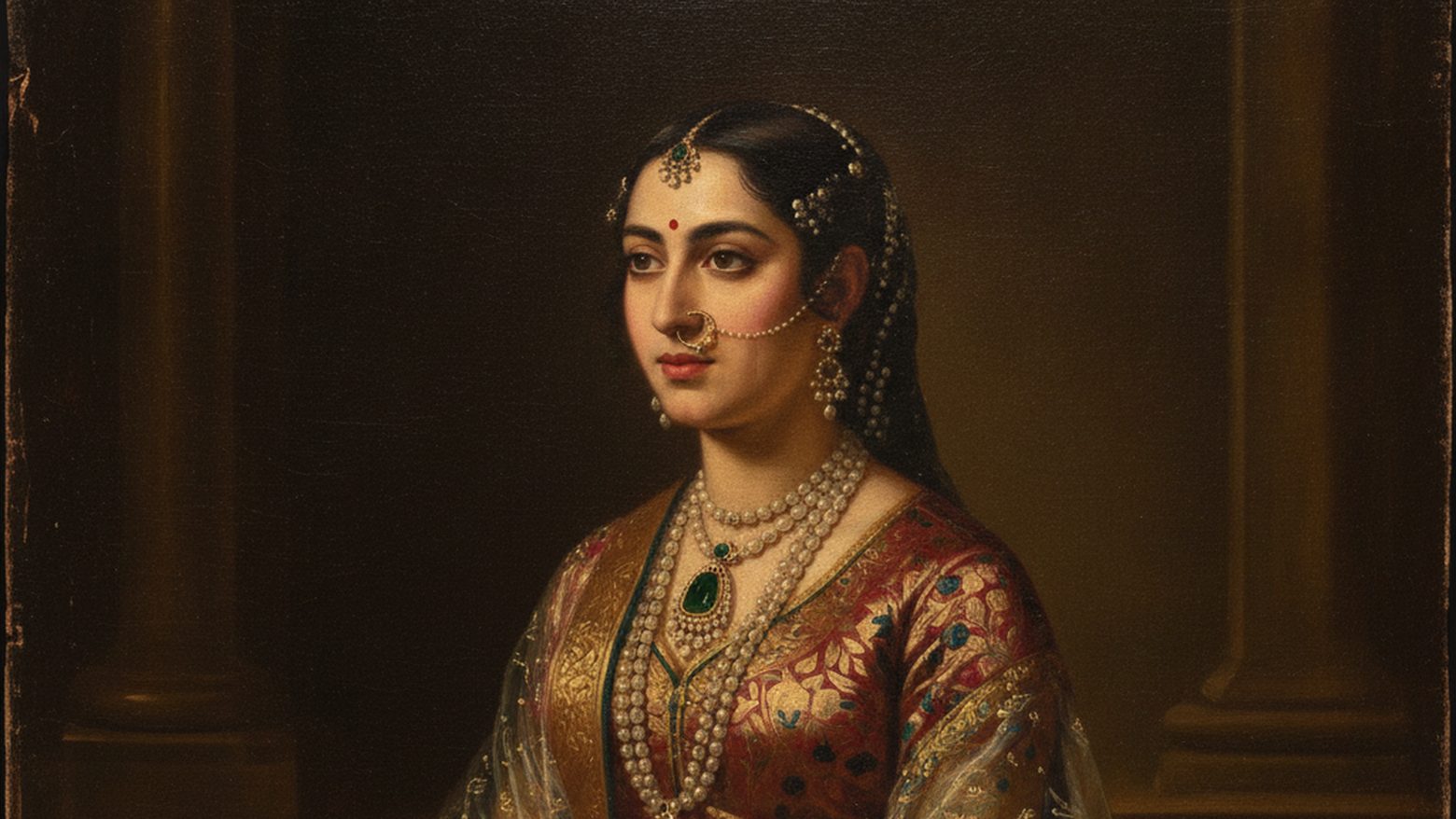
For the best part of twenty years, one of the more consequential paintings in British art history was kept in a sleeping bag. Not in a vault, not in a museum store with a climate log and a conservator's condition report — in a padded nylon sack, in the house of a retired accountant in Scotland, because that seemed like a sensible way to stop it getting knocked. Its owner, Mary-Louise Wedderburn, had inherited it from an uncle two decades earlier along with a family suspicion she could never prove: that the woman who painted it was a relative.
On 23 July 2026, on an episode of BBC One's Fake or Fortune?, she was told she had been right. The picture — a young Indian woman in layered pearls, a heavy emerald pendant at her throat, a fine gold ring through her nose, sitting in the stiff formal pose of a European state portrait — is by Katherine Read, born in Dundee in 1723, dead at sea off Madras in 1778. On the evidence assembled, it is the earliest recorded portrait of an Indian sitter painted by a European woman. Philip Mould valued it at upwards of £100,000.
The number is the least interesting thing about it.
The Jacobite daughter who had to leave
Katherine Read — the literature spells her Catherine about as often, which is its own small symptom of the problem — was the fifth of thirteen children of an affluent Forfarshire family. That comfort ended in 1746. Her mother's brother was Sir John Wedderburn, 5th Baronet, who came out for the Stuarts in the '45 and was executed for it after Culloden. Families on the wrong side of that line did not stay in Scotland if they could help it. The Reads went to Paris.
Exile turned out to be the making of her. In Paris she entered the orbit of Maurice Quentin de La Tour, the supreme pastellist of the French eighteenth century, a man who could make chalk look like breathing skin. She had reportedly had earlier instruction from the engraver Robert Strange, himself a Jacobite fugitive; sources also place her in the studio of Louis Blanchet. The precise sequence is contested — the documentation for women's training in this period is thin, and later biographers have not always agreed. What is not contested is the result: she came out of Paris able to handle pastel at a level almost no one in Britain could match.
From 1750 to 1753 she worked in Rome under the patronage of Cardinal Albani, copying masterworks for clerical patrons — the standard finishing school for an ambitious painter, and one a Protestant Scotswoman had no obvious business attending. Then, in 1753, she met Rosalba Carriera in Venice, the greatest pastellist in Europe and by then almost entirely blind. Read wrote to her three times before Carriera's death, calling her an artist without equal and praising the honour she brought to her sex. It reads less like fan mail than like someone establishing a lineage for herself, because no one else was going to.
She could not join the Royal Academy as a full member, could not draw from the nude model, could not sign her work into the canon. So she built a genealogy out of letters instead.
The English Rosalba, and the ceiling she hit
London made her fashionable fast. From 1753 she was one of the portraitists that aristocratic women and their children were painted by, and Queen Charlotte sat to her. Horace Walpole — the period's most quotable snob — called her the English Rosalba
, which was both a considerable compliment and a neat way of defining her by a woman who had already been safely categorised. She exhibited almost every year from 1760 with the Society of Artists, the Free Society and the Royal Academy, and in 1769 she was made an honorary member of the Society of Artists alongside Mary Benwell and Mary Black.
Honorary. That word does the quiet work. Read was commercially successful, technically formidable and socially connected, and the institutions of British art still had no category for her that wasn't a courtesy title. When the Royal Academy was founded in 1768 with two women among its founders, Angelica Kauffman and Mary Moser, it then closed the door behind them for a century and a half. Read was on the wrong side of it. Art UK's survey of her career sets out how narrow the available path was even for a woman at the top of the profession.
So in 1771, at forty-eight — an age at which most eighteenth-century painters were consolidating, not gambling — she got on a ship to India.
Madras, and a different kind of market
The stated reason was money: East India Company officers in Madras and Calcutta had fortunes and no one to paint them. She took her niece Helena Beatson, herself a capable artist, who in 1777 married Charles Oakeley, later Governor of Madras. Read is documented in India in 1775 and 1777, and died at sea near Madras on 15 December 1778, aged fifty-five, apparently on her way home.
The Indian years are where her record goes thin, and where this new painting lands. European artists in eighteenth-century India were overwhelmingly men — Tilly Kettle, Johan Zoffany, the Daniells — working a colonial market, painting Company men and, occasionally, the Indian rulers those men needed to flatter. The traffic of looking ran one way, through male eyes.
A portrait of an Indian woman, by a European woman, in that decade is a different object. It implies access to a domestic and female world Kettle and Zoffany simply did not have. The sitter has not been identified; the working hypothesis is that she was the wife of a nawab. That is a hypothesis, not a finding, and worth holding loosely — but the social logic is sound. A woman painter could be admitted where a man could not.
How they proved it
The attribution rests on three legs, none of them a signature. First, technical comparison: the programme's researchers matched pigments, the modelling of flesh and the brushwork against securely attributed Reads — including, with a pleasing circularity, her portrait of the niece who travelled to India with her. Second, documents: letters and wills that placed the painting's descent inside the family. Third, the judgement of a specialist. The independent art historian Charles Greig put it without hedging: On the basis of all the evidence put together, I am entirely certain that this painting is by Katherine Read.
The story was picked up widely, including by Smithsonian Magazine.
And here the Wedderburn name closes a loop that is almost too neat for fiction. Read's mother was a Wedderburn. Her uncle died on a scaffold for the Stuart cause, and the family scattered. Two hundred and fifty years later the painting surfaces in the hands of a Wedderburn who had always half-known. The picture never really left the family; it just stopped being legible to it. That is how most provenance actually works — not as a clean chain of title but as a long game of institutional forgetting, punctuated by someone finally asking the question out loud. It is the same mechanism we traced in provenance and the story behind the painting.
The pattern: Read keeps getting reassigned
This is not the first time Read has been handed back something that was taken from her. In 2023, Artnet reported that a Florida museum had renamed Katherine Read as the artist behind a major eighteenth-century portrait it had long assumed was the work of a man. The default assumption, when a good eighteenth-century picture has no signature, has historically been that a man made it. Read's catalogue has been quietly bleeding into the work of better-known male contemporaries for two centuries, and the correction is only now running the other way.
That pattern is the real story, and it is not confined to her. It is the same shape as Sofonisba Anguissola's rediscovery, where a Renaissance portrait spent generations under a man's name; the same as Emily Sargent's watercolours, 440 of them sealed in a trunk for 62 years because the archive that mattered was her brother's; the same as the long critical rehabilitation of Berthe Morisot, who was at the centre of Impressionism and got filed as its ornament. In each case the work was never lost. The attribution was.
What we still do not know
The coverage has been enthusiastic, so the caveats matter. This attribution was made for a television programme — no criticism of the scholarship, since Fake or Fortune? has a strong record and Greig is a serious specialist, but it is not a peer-reviewed catalogue entry and has not been tested by other scholars in print. Attributions built on connoisseurship and provenance, without a signature or a commission record, are revisable by definition. Earliest recorded
is a claim about the surviving record, not about what actually happened, and documentation of European women in India is patchy enough that it could shift again. The sitter remains anonymous; the nawab's-wife theory is inference. And £100,000 is a valuation, not a realised price.
None of which diminishes the object. A painting that spent two decades in a sleeping bag is now the earliest known evidence of a European woman painting an Indian woman, made by a Dundee exile who sailed to the other side of the world at forty-eight because the art world at home had offered her a courtesy membership and nothing else. The looking that recovers a picture like this — slow, sceptical, willing to doubt the label — is the same skill reading any masterpiece demands.
The National Portrait Gallery files her under yet another spelling, Katharine. Three versions of a name, for a woman whose work we are still sorting back into her own hands.
Frequently asked questions
Who was Katherine Read? Katherine Read (1723–1778), also spelled Catherine, was a Scottish portrait painter born in Dundee. Trained in Paris and Rome, she became one of the most sought-after pastellists in London, exhibited regularly from 1760, and counted Queen Charlotte among her sitters. Horace Walpole called her the English Rosalba
. In 1771 she sailed to India, and she died at sea near Madras in December 1778.
What was discovered on Fake or Fortune in July 2026? A portrait of an unidentified Indian noblewoman, owned by retired accountant Mary-Louise Wedderburn and stored in a sleeping bag, was attributed to Katherine Read in an episode broadcast on 23 July 2026. The art historian Charles Greig confirmed the attribution and Philip Mould valued the painting at more than £100,000.
Why is the portrait historically important? It is described as the earliest recorded portrait of an Indian sitter painted by a European woman artist. Most eighteenth-century European images of India were made by men working around the East India Company, so a painting by a woman who lived and worked there changes the known record of who was permitted to look at whom.