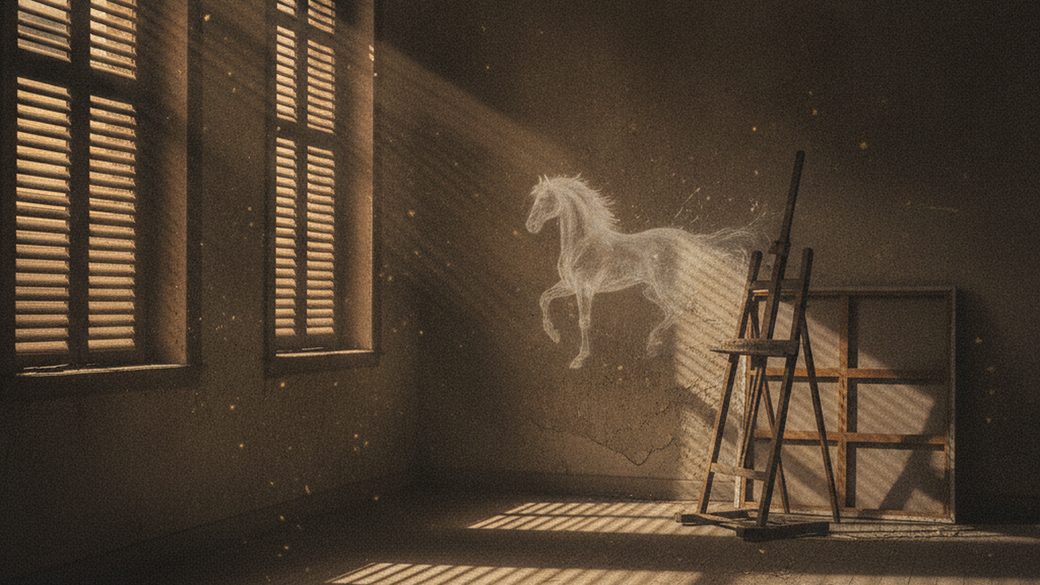
In the summer of 1940, a twenty-three-year-old woman sat in a room in a private clinic on the hills above Santander, in the north of Spain, and painted a small picture. She was not there by choice. Her family had committed her; the doctors were giving her injections that threw her body into convulsions; and Europe outside the shuttered windows was coming apart. When she was finally released, she left the painting behind, a gift to the psychiatrist who had run the place. Then she vanished into her own extraordinary life, and the picture stayed on the Morales family's wall in Spain for more than eighty years. Its name is Villa Pilar, and in 2026 the world is seeing it for the first time.
The woman was Leonora Carrington (1917–2011) — English by birth, Mexican by adoption, and one of the strangest and most original imaginations the twentieth century produced. For most of her career she was filed under the small print of surrealism, a beautiful footnote to the men. That has changed with startling speed. In May 2024 her canvas Les Distractions de Dagobert sold at Sotheby's for 28.5 million dollars — a record for the artist and for any British-born woman painter, and a leap of some seven hundred per cent over her previous auction high. Against that backdrop, the quiet reappearance of a painting she made at the lowest point of her life carries an unusual charge.
The runaway debutante and the birdman
Carrington was born into money and expectation — a Lancashire textile fortune, a debut at the court of George V, convent schools that expelled her for being ungovernable. She wanted none of it. In 1937, at nineteen, she met the German surrealist Max Ernst at a London dinner. He was forty-six and married; within months she had run off with him to France, to a farmhouse at Saint-Martin-d'Ardèche that they covered together in sculptures and murals of chimerical beasts. It was, by every account, the happiest and most productive stretch of her early life. It did not last.
When war broke out, Ernst — a German national on French soil — was arrested as an enemy alien
and interned. Carrington, left alone as the fabric of her world dissolved, fled south into Spain. Somewhere on that journey she came apart. What she later described was a full psychotic break: paranoia, hallucinations, the conviction that she could stop the war by force of will. In Madrid the crisis peaked, and her parents — reachable even in wartime through the family's business connections — arranged for her to be placed in the sanatorium of Dr Luis Morales outside Santander.
Cardiazol, and a picture called Villa Pilar
She was there roughly six months. The treatment was brutal by any modern standard: she was given Cardiazol, a convulsant drug used before electroshock to induce seizures deliberately, in the belief that the violence of the fit might reset a broken mind. Carrington experienced it as torture, and she never forgot it. Years later she turned the whole ordeal into a short, ferocious memoir, Down Below, first published in 1944 — one of the most vivid first-person accounts of madness and its so-called cures ever written by an artist.
The clinic's buildings had names. One wing was called Down Below; another was Villa Pilar. Both became titles of paintings she made during her confinement — the only two works known to survive from those months. Villa Pilar is the smaller, gentler of the pair, and when Carrington was discharged she left it with Morales himself. Whether it was thanks, or payment, or simply something she wanted gone, we do not know for certain. What is certain is that it never entered the art market. It hung in the doctor's family home in Spain and passed quietly down the generations, unseen by the scholars who spent decades reconstructing this exact chapter of her story.
She painted the room that was breaking her, and then walked out of it into the rest of her century.
Its existence surfaced in print only recently, in Joanna Moorhead's 2023 biography Surreal Spaces: The Life and Art of Leonora Carrington. From there the trail led back to Santander, where the curatorial team at the waterfront cultural centre Faro Santander tracked the picture down — still with the Morales family, still on their wall. That an object so central to one of surrealism's founding myths could sit unrecorded in a private house for the better part of a century is a reminder of how much of art history depends on luck, persistence and a stranger deciding to answer the door. It is the same lesson that runs through every good story of provenance and rediscovery: the record is never as complete as it looks.
The escape, and the making of a Mexican surrealist
What happened after Santander is the stuff of a thriller. Facing the threat of transfer to another institution in South Africa, Carrington slipped away from her minders in Lisbon and took refuge in the Mexican embassy. There she made a coldly practical decision: she married Renato Leduc, a Mexican diplomat and poet she knew slightly, because his passport was a door out. The marriage got her to New York and then to Mexico City, where it quietly dissolved once it had done its work.
Mexico remade her. In its light, and in the company of the exiled Spanish painter Remedios Varo, Carrington found the world her imagination had been looking for. The two women became close friends and fellow travellers in a private mythology of alchemy, tarot, folklore and animal spirits, and together they are now seen as the heart of Mexican surrealism. Carrington lived and worked in Mexico City for the rest of her long life, dying there in 2011 at ninety-four, revered in her adopted country and only belatedly rediscovered in the one where she was born.
Why a small painting matters
What makes Villa Pilar more than a biographical curiosity is where it sits in her development. It was painted at the exact hinge of her life — after the idyll with Ernst, inside the breakdown, before the reinvention in Mexico. The recurring signs of her mature work, above all the horse, her lifelong emblem of freedom and escape, are already stirring in these Santander pictures. To stand in front of it is to watch an artist assembling her private symbols in real time, under conditions designed to erase her personality altogether. The kind of slow, patient looking that reveals this is exactly what we mean by reading a masterpiece.
The painting has surfaced as the anchor of Leonora Carrington: The Symptomatic Surreal at London's Freud Museum, curated by Vanessa Boni — fittingly, in the last home of the man whose theories shadowed the whole surrealist project. It is the first institutional show devoted to Carrington's Santander sketchbooks, and it sets her motifs of horses and the underworld beside Freud's own collection of antiquities on those themes. The exhibition, extended by popular demand, runs until 10 August 2026 before Villa Pilar travels home to Faro Santander from 8 September. The story was first reported in detail by The Art Newspaper.
A word of honest caution is due. This is not a museum-vetted masterpiece arriving with a fat catalogue of scholarship; it is a privately held painting whose full history rests heavily on Carrington's own memoir, itself a shaped and literary account of a period she experienced in extremity. Much about the Santander months remains uncertain, and Morales, tellingly, came to believe in later years that his most famous patient had never truly been mad at all. What is not in doubt is the strange fact at the centre of it: that a young woman, drugged and confined and stripped of everything, made a picture — and that the picture outlived the room, the doctor, the war and the woman herself. Like the resurfacing of other long-lost works, from Sofonisba Anguissola to the Renaissance masters, it is proof that a reputation can be lost and found again. That, in the end, is the whole art legacy: the things we make outlast the worst that is done to us.
Frequently asked questions
Who was Leonora Carrington? Leonora Carrington (1917–2011) was a British-born surrealist painter and writer who fled wartime Europe and settled in Mexico, where she became a central figure of Mexican surrealism alongside Remedios Varo. In 2024 her painting Les Distractions de Dagobert sold for 28.5 million dollars, a record for a British-born woman artist.
What is Villa Pilar? Villa Pilar is a small painting Carrington made in 1940 while confined at Dr Luis Morales's sanatorium outside Santander, Spain. She gave it to Morales on leaving, and it stayed with his family for more than eighty years before its first public showing in 2026.
Where can I see Villa Pilar? It is on show at London's Freud Museum in Leonora Carrington: The Symptomatic Surreal until 10 August 2026, then travels to Faro Santander in Spain from 8 September 2026 to 10 January 2027.