Of all the materials an artist can put on a surface, only one is worth more than the work it decorates. Gold has been in art longer than paint as we know it, and for a simple, almost magical reason: it does not corrode, tarnish or fade. Bury it for a thousand years and it comes up still shining. To ancient eyes, that made it the closest thing on earth to eternity — and so, wherever people wanted to picture the divine, the eternal or the priceless, they reached for gold.
The oldest luxury
Gold enters art as gold leaf — gold hammered so thin it becomes almost weightless, thinner than a tenth of a thousandth of a millimetre, so fine it turns translucent green when you hold it to the light. The Egyptians gilded coffins and gods with it; the technique of laying whisper-thin sheets over wood, plaster or stone, called gilding, has barely changed in three millennia. A little gold, spread thin enough, can make an entire object look solid and precious. That illusion — vast value from a sliver of material — is the whole economy of gold in art.
Gold is the only pigment that is also a promise: it says this will still be shining long after we are gone.
Byzantium: a background made of heaven
The first great flowering came in the icons and mosaics of the Byzantine world. Walk into a church like San Vitale in Ravenna and the walls glow with acres of gold tesserae. But look closer and notice what the gold is doing: it isn't a wall, a sky or a room. It is nothing — a shimmering, placeless void behind the saints. That was deliberate. The gold ground lifts the holy figures out of ordinary space and time into pure, eternal light. Flickering candlelight made the mosaics move; the divine seemed to hover in a heaven with no floor and no horizon. It is one of the boldest abstractions in art history, made a thousand years before we had the word for it.
Klimt and the Golden Phase
Gold's most famous modern chapter belongs to Gustav Klimt. The son of a gold engraver, he grew up with the material in his hands, and around 1900 he turned it into a signature. His "Golden Phase" produced the most reproduced images of the era: The Kiss (1907–08), two lovers dissolving into a single shimmering cloak of gold leaf, and the Portrait of Adele Bloch-Bauer I (1907) — the "Woman in Gold" — in which a real Viennese woman is half-consumed by a glittering field of ornament.
Klimt used real gold and silver leaf, fusing the flatness of Byzantine icons and Japanese screens with modern portraiture. The gamble paid off across a century: in 2006 the Woman in Gold sold to Ronald Lauder for a reported 135 million dollars — at the time the highest price ever paid for a painting. The material that once signalled heaven now signals, among other things, the top of the art market. Two decades later another Klimt pushed that ceiling far higher — see the story of the record-breaking Portrait of Elisabeth Lederer.
Kintsugi: gold in the cracks
Not every culture used gold to gild a surface. In Japan, the art of kintsugi (金継ぎ, "golden joinery") does the opposite: when a precious ceramic bowl breaks, the pieces are rejoined with lacquer dusted with gold, so the repair becomes a bright golden seam rather than a hidden flaw. The break is not disguised — it is honoured. Rooted in the wabi-sabi love of the imperfect and impermanent, kintsugi treats a history of damage as part of an object's beauty, sometimes making the mended bowl more valued than the flawless one. It is the gentlest idea in all of gold's story: that what is broken can be made more beautiful, and more valuable, precisely where it was hurt.
Black and gold, now
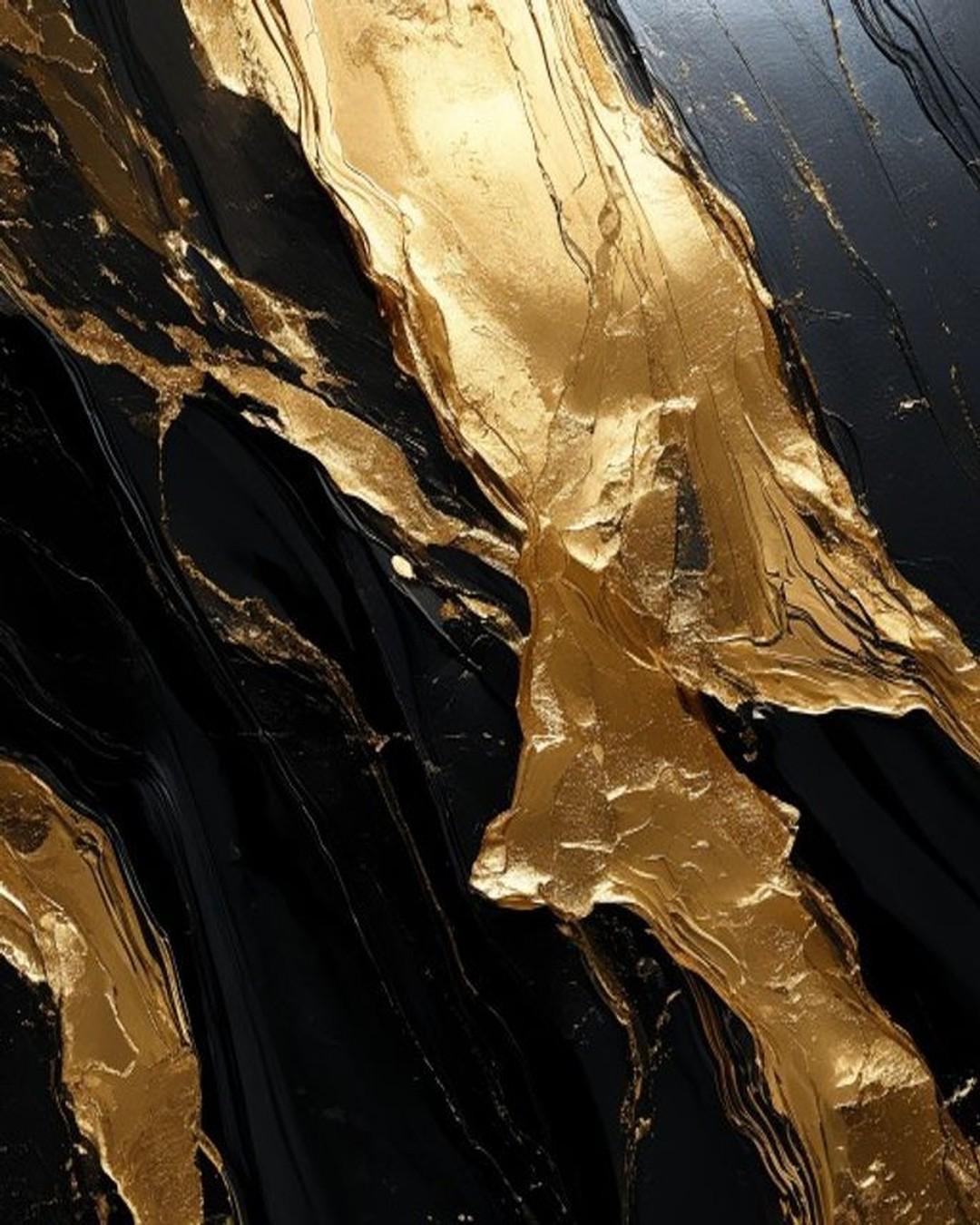
Contemporary abstraction has rediscovered the oldest trick of all — gold against darkness. Set molten gold running through glossy black, as in the work above, and every lesson from Byzantium returns at once: the gold reads as light, as wealth, as something almost alive, precisely because the black around it gives it nothing to compete with. It is the same logic as the gold ground and the kintsugi seam — value made visible by contrast. Three thousand years on, we are still doing what the Egyptians did: taking the one material that will never fade, and using it to point at whatever we most want to last.