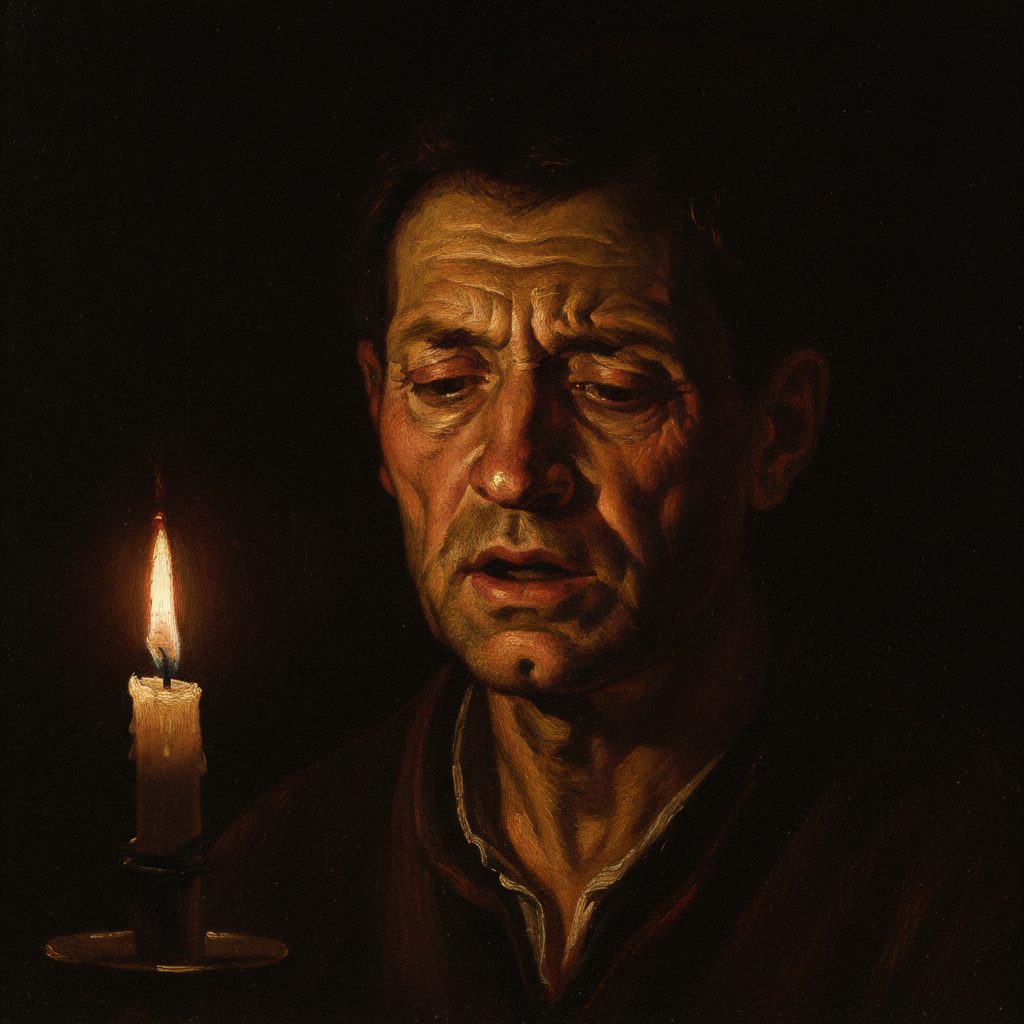
Stand in front of a great Baroque painting and the first thing that reaches you is not the story — it is the light. A face surfaces out of deep brown darkness; a hand catches a beam from somewhere off the canvas; the shadows feel thick enough to hold. That effect has a name: chiaroscuro, from the Italian chiaro (light) and scuro (dark). It is the art of modelling form through the contrast of the two, and for a few centuries it was the closest thing painting had to a superpower.
Why it mattered
The problem every painter faces is that a canvas is flat, and the world is not. Chiaroscuro is the solution: by grading tone carefully from light to dark across a form, an artist can make a flat surface bulge into a convincing sphere, a cheek, a fold of cloth. Master the transition of light into shadow and paint stops being a coloured pattern and starts being a body you could reach out and touch. Beyond that illusion of volume, the strong opposition of bright and dark carries pure emotion — it is theatrical, tense, and impossible to ignore.
Leonardo lights the way
The Renaissance made the breakthrough. Leonardo da Vinci refined sfumato, the delicate smokelike blending of light into shadow with no hard edges, giving his faces their uncanny softness and life. He understood that in reality we rarely see a sharp line where light ends; we see a gradual dissolve. Capturing that dissolve was the first great step, and it made every figure that followed more real.
Give a painter control of the light and you give them control of your attention, your eye, and your feeling — in that order.
Caravaggio turns up the contrast
Then, around 1600, Caravaggio did something radical. He pushed the contrast to its extreme, plunging his backgrounds into near-total blackness and letting a single, hard, raking light slice across his figures. This intensified form of chiaroscuro is called tenebrism (from tenebre, darkness). The effect is shocking even now: saints and street people alike loom out of the void, caught as if by a spotlight, every wrinkle and dirty fingernail lit with brutal clarity.
Caravaggio's light was not gentle modelling; it was a drama, a spotlight on a stage, and it made the sacred feel immediate and human. His influence spread so fast across Europe that a whole generation of followers earned a nickname — the Caravaggisti.
Rembrandt gives shadow a soul
In the Dutch north, Rembrandt van Rijn took the same tools somewhere warmer and more inward. His light does not merely reveal a body; it seems to glow from within the scene, pooling on a forehead or a collar and letting everything else fall into a soft, living gloom. He used it above all in his portraits and self-portraits, where the interplay of warm light and deep shadow becomes a way of painting character — thought, age, doubt, dignity. A specific soft triangular highlight on the shadowed cheek is still taught to photographers today under the name Rembrandt lighting. His shadows are never empty; they feel full of everything the light chose not to say — sometimes literally, as when a rediscovered early Rembrandt was found to hide a whole second painting beneath a later hand's overpaint.
The technique never went dark
Chiaroscuro did not stay locked in the seventeenth century. Every time a film noir detective's face is half-swallowed by shadow, every time a cinematographer lights a single actor out of a black room, every dramatic portrait shot with one hard lamp — that is Caravaggio and Rembrandt, working through a camera. The vocabulary of dramatic lighting we now take for granted on screen was worked out, brushstroke by brushstroke, on canvas four hundred years ago.
That is the real legacy of chiaroscuro: it proved that the control of light is the control of meaning — and it is what allows a single red held against black to carry a whole picture on its own. Decide what to illuminate and what to leave in darkness, and you decide what your viewer feels. It is the same lesson the Renaissance masters taught, distilled to its most powerful form — and the first thing to look for when you set out to read a masterpiece.