The painting was hanging in a hallway that led to the garage. That is the detail worth holding on to, because everything else about this story has been told as a lottery ticket and it is not one. A hallway to a garage is where a house puts the pictures it has stopped seeing. In July 2026, at an estate sale in Michigan, a man who had come for records and midcentury furniture walked past it, walked back, and paid $30.
On 1 October 2026, at Freeman’s in New York, the same object — an oil on masonite panel measuring eight by eleven inches, still in its original frame — was knocked down at $1,060,000. With the buyer’s premium the total came to $1,352,600. The estimate had been $150,000 to $250,000. Bidding opened at $80,000, five telephone bidders went to work, and the hammer fell at more than seven times the low estimate.
The arithmetic that went round the world is simple enough: thirty dollars in, one and a third million out, a return of roughly 45,000 times. It is also, as an explanation, completely useless. What actually turned a $30 board into a record was not luck. It was a museum catalogue, three institutions, and a woman who has been dead for forty-nine years finally being looked at properly.
Nine shells and a thread
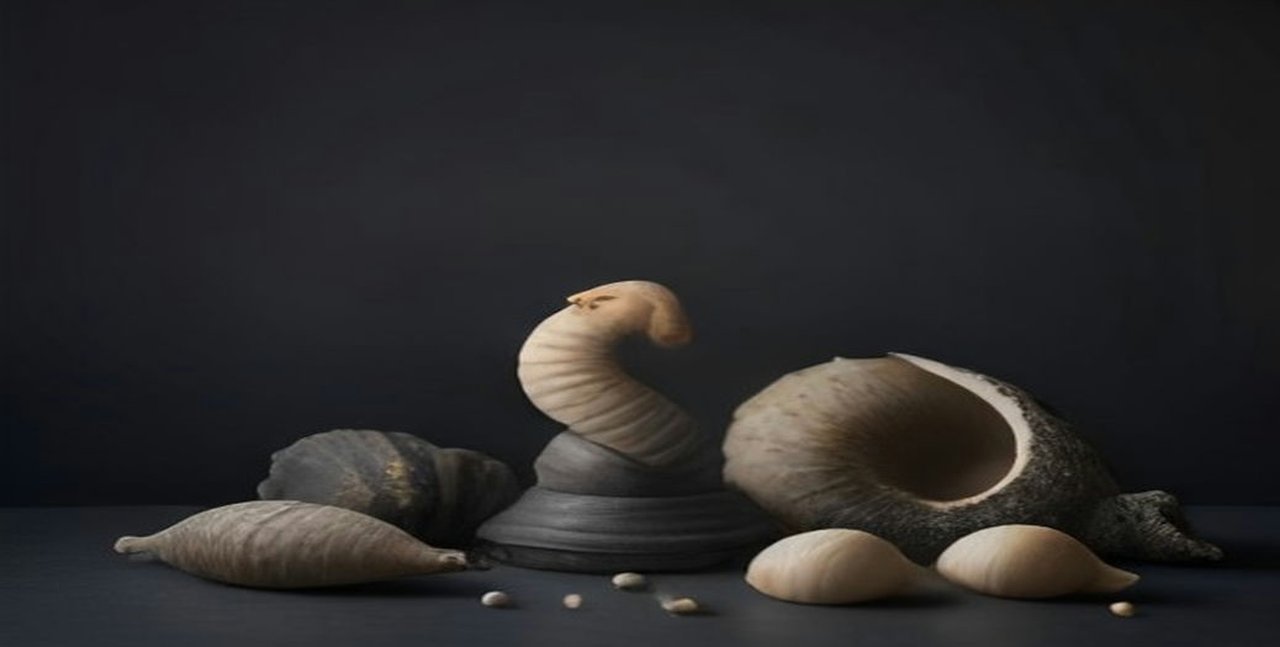
The picture is called Alderman Merriam’s Shells, painted in 1951. Nine seashells sit on a slate-grey surface against a black ground. One of them, a small conical spiral, hangs on a thread above the rest, which is the sort of thing Gertrude Abercrombie did constantly and never explained.
The title is literal. The shells belonged to Robert Merriam, who represented Chicago’s 5th Ward — Hyde Park, Abercrombie’s own neighbourhood — as alderman from 1947 to 1955. She borrowed a neighbour’s shell collection, arranged it on a table, and painted it at the scale of a paperback. That scale matters. Abercrombie almost never painted large. Her pictures are domestic objects, made to be held at the distance of a conversation, which is one reason so many of them ended up in ordinary houses rather than in collections.
She was not a painter whose work went into bank lobbies. It went into the houses of people she knew, and then into the houses of their children, and then into hallways.
The doctor who was paid in paintings
Here is how the panel reached that Michigan hallway. In 1952, Abercrombie gave it to Dr John Reynolds of Kalamazoo in exchange for medical services. It stayed with the Reynolds family until the estate sale three-quarters of a century later.
Artists have always paid their doctors and dentists in work, and it is one of the quietest ways a body of work disperses. A painting that enters a collection enters a record: it gets an inventory number, an insurance valuation, a line in a will. A painting that settles a medical bill enters nothing. There is no bill of sale, no gallery stockbook, no photograph. It simply moves into a private house in another state and goes dark.
Before it went dark, though, it had a short public life, and that turned out to be decisive. The panel was shown between 1952 and 1953 in New York, Chicago, Milwaukee and Evanston. It appeared at the Newman Brown Gallery in Chicago in 1952, where the Chicago Tribune reviewed the show and ran a photograph that included the actual shells. After a last recorded appearance at the Illinois Design Center in Chicago, it vanished from the public record for roughly seventy-four years.
The catalogue did the work
Now the part that the headlines skip. The man who bought the painting did not know what he had, not with any certainty. What he did was take a detour on a family holiday to visit Gertrude Abercrombie: The Whole World Is a Mystery at the Milwaukee Art Museum, which ran from 27 March to 19 July 2026.
That exhibition was the third stop of a touring retrospective of nearly eighty paintings that had opened at the Carnegie Museum of Art in Pittsburgh on 18 January 2025, travelled to the Colby College Museum of Art in Maine from 12 July 2025 to 11 January 2026, and finished in Milwaukee. Its catalogue reproduced a photograph of the lost panel alongside that 1952 Tribune review — the review with the shells in it. Comparison was no longer a matter of connoisseurial feel. It was a matter of counting shells. The attribution was then confirmed by Susan Weininger, professor emerita of art history at Roosevelt University and the scholar who has done more than anyone to reconstruct Abercrombie’s catalogue.
So the chain runs: three museums spend three years and a great deal of money assembling a scholarly record of a regional painter; that record is printed and sold in a gift shop; a picker on holiday reads it; a lost picture re-enters the market at a price 45,000 times what it cost. The $30 is the hook. The catalogue is the mechanism. This is the same unglamorous pattern we found when a Constable study surfaced in Texas and when a Tudor pendant made £5,588 at a provincial sale: objects are not usually rediscovered by instinct, they are rediscovered by somebody having read the right page.
The queen of the bohemian artists
Abercrombie was born in Austin, Texas, in 1909 and brought to Chicago as a child. She took a degree in Romance languages at the University of Illinois in 1929, studied figure drawing at the Art Institute and commercial art at the American Academy, and then spent her entire working life in Hyde Park, mostly in one house on Dorchester Avenue.
It was a famous house. She called herself the queen of the bohemian artists and behaved accordingly: her rooms were a jazz salon through the bebop years. Dizzy Gillespie played at her wedding in 1948 — her second husband, Frank Sandiford, was a music critic — and Charlie Parker, Sarah Vaughan, Sonny Rollins, Max Roach and the Modern Jazz Quartet moved through the place. The connection was not decorative. Her pictures work the way a small combo does: a handful of motifs, stated plainly, recombined endlessly — a tower, a door, an owl, a black cat, a moon, a crystal ball, a lone woman in a long dress who is always, unmistakably, her. “It is always myself that I paint,” she said.
And then it stopped. By the late 1950s there was money trouble, arthritis and heavy drinking; after 1959 the output thinned badly; eventually she was in a wheelchair and then in bed. In her last year the Hyde Park Art Center mounted a retrospective, 28 January to 5 March 1977. She died on 3 July that year, aged sixty-eight. The pattern — a woman artist with a real following in her own city, then four decades of near-silence, then a museum retrospective that re-prices everything — is one this site keeps running into, most recently with Leonora Carrington and with Berthe Morisot.
What the number actually means
The record is real and it is worth putting in context rather than simply gasping at.
The previous Abercrombie high was $1,016,000, paid for Message for Mercy (1950) at Sotheby’s on 21 November 2025. The new figure beats it by $336,600, a rise of about 33 percent in eleven months. Against the broader market that is a steep jump: artnet’s market guide puts her average auction price over the preceding twelve months at roughly $133,890, with annual turnover peaking in 2025 — the year the retrospective opened.
One figure from the sale itself says more than the record does. Freeman’s postwar and contemporary auction on 1 October totalled $3,449,560, with 88 percent of lots sold and bidders from twelve countries, 23 percent of them new to the house. A single eight-by-eleven-inch panel therefore accounted for roughly 39 percent of the entire sale. That is not a market broadly revaluing an artist. That is one object, with a once-in-a-career story attached, behaving like an event.
Which is the honest caveat. Fresh-to-market works carry a premium, and works with a narrative carry a larger one; a picture that has been missing for seventy-four years, documented in a museum catalogue, and bought for $30 is about as narrative as an object gets. None of that makes the painting less good, but it does mean the $1.35m should not be read as the new baseline for a small Abercrombie still life. Retrospective-driven spikes usually settle. It is also worth noting that the finder has stayed anonymous, so the hallway, the $30 and the detour to Milwaukee reach us through Freeman’s and the reporters who covered the sale rather than from an independent record — the facts are consistent across those accounts, but they are one source deep.
The useful lesson is not “check your attic”
Every story like this produces the same reflex, and it is the wrong one. The odds of finding a million-dollar panel in a hallway are not odds you can act on.
The thing that is repeatable is what the buyer did after the purchase. He had an object he could not name, and instead of putting it on an auction site as “midcentury still life, artist unknown”, he went and looked at eighty paintings by the artist he suspected, read the catalogue, and found the photograph. That is research, and it is available to anyone with a museum ticket. The modern tools help — we have written about how a phone camera matched a lost medieval panel to its catalogue entry — but they are only as good as the scholarship they are searching against, and that scholarship is built slowly, by curators, in exhibitions that rarely make money.
The deeper point is the one that governs every rediscovery: value in art is not stored in the object, it is stored in the paper trail attached to it, as we have argued at length in our piece on provenance and the story behind a painting. For seventy-four years Alderman Merriam’s Shells was worth whatever a nice small still life is worth in Kalamazoo. The pigment never changed. What changed is that somebody finally rebuilt the record it had fallen out of — and the moment the record came back, so did the money.
Frequently asked questions
How much did the Gertrude Abercrombie estate sale painting sell for? Alderman Merriam’s Shells (1951) made $1,060,000 at the hammer and $1,352,600 with premium at Freeman’s, New York, on 1 October 2026, against a $150,000–250,000 estimate. It had cost $30 at a Michigan estate sale in July 2026 — a return of roughly 45,000 times — and set a new record for the artist, 33 percent above the $1,016,000 paid for Message for Mercy at Sotheby’s on 21 November 2025.
How was the Abercrombie painting identified? The buyer detoured on a family holiday to the touring retrospective Gertrude Abercrombie: The Whole World Is a Mystery at the Milwaukee Art Museum. The catalogue reproduced a photograph of the missing work beside a 1952 Chicago Tribune review of her Newman Brown Gallery show, which pictured the actual shells. Susan Weininger, professor emerita at Roosevelt University, confirmed it.
Who was Gertrude Abercrombie? An American painter (1909–1977) based in Hyde Park, Chicago, who called herself the queen of the bohemian artists. Her house was a bebop-era jazz salon — Dizzy Gillespie played at her 1948 wedding — and she painted small, spare, dreamlike pictures of towers, doors, owls, cats, moons and shells. “It is always myself that I paint.”