In March 1547 the people of Rome looked up at the top of an unfinished palace on the Campo de' Fiori side of the city and saw something absurd: a piece of cornice, full size, made of wood, hanging in the air. It had been winched into position on one corner so that it could be looked at from the street. This was the test. Michelangelo Buonarroti, then in his early seventies and the most famous living artist in Europe, had just won the commission to crown the Palazzo Farnese, and rather than argue about drawings he built the thing at full scale, hoisted it into the sky, and let the piazza decide.
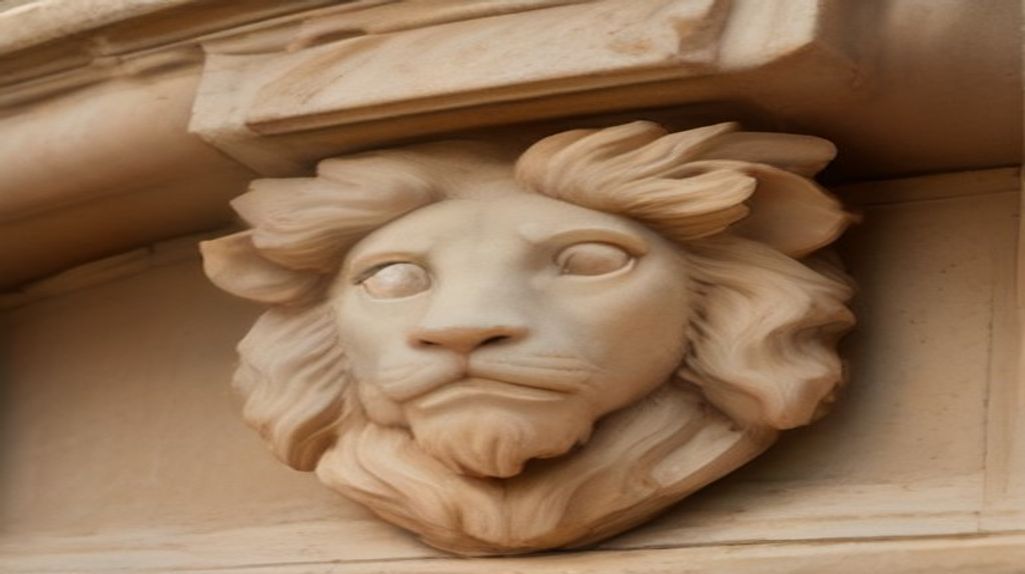
The piazza approved. The cornice went up in travertine, and for four and a half centuries it has been the single most influential horizontal line in European architecture — the element every palace built after it had to answer to. This summer the scaffolding finally came down from a five-year restoration of the palace's roofs and facades, and the people who spent those years up there at eye level with Michelangelo's stone came back with something nobody expected: out of roughly three hundred carved lion heads running around the building, they think exactly one was cut by Michelangelo himself.
A competition nobody else could win
The Palazzo Farnese was begun in 1517 for Cardinal Alessandro Farnese, a man with a long game. When he was elected Pope Paul III in 1534 the house he was building stopped being a cardinal's residence and started being a dynastic statement, and it grew accordingly. Its architect was Antonio da Sangallo the Younger, the most technically accomplished builder in Rome, who quarried travertine for it out of the Colosseum — an ordinary act of recycling at the time, and one that tells you exactly how the sixteenth century regarded the ruins it lived among.
Sangallo died in 1546 with the palace unfinished and, critically, with the crowning cornice unresolved. A cornice sounds like a detail. On a building this size it is the entire argument: the projecting shelf at the roofline that gives a facade its weight, its shadow and its final proportion. Paul III opened it to competition. Michelangelo won.
What he then did was characteristically unreasonable. Instead of scaling his cornice to the top storey, as convention required, he scaled it to the whole building — making it far deeper and heavier than any rule allowed, so that it reads correctly when you stand across the piazza and take in all three floors at once. It is a piece of design solved for the viewer's eye rather than for the drawing board, which is why the wooden mock-up mattered. He was not showing off. He was checking.
The cornice is proportioned not to the wall it sits on, but to the building it finishes. That is the whole idea, and it is why nobody had done it before.
This is Michelangelo working in the mode we tend to forget he had. We remember the ceiling and the David; the last two decades of his life went largely into architecture — St Peter's, the Campidoglio, the Farnese cornice. If you have followed our reading of the period's Renaissance masters as working practitioners rather than brand names, this is the purest example: a sculptor solving a drainage problem and producing a masterpiece by accident of rigour.
Three hundred lions, and what they were actually for
Because that is the other thing about the cornice. Those lion heads are not ornament bolted onto a fancy roofline. They are plumbing.
The lion-head course functioned as the palace's rainwater drainage system, throwing water out and away from the travertine and brick below — the difference, over centuries, between a facade that survives and a facade that rots from its own runoff. Roughly three hundred of them run around the building, and the detail that has charmed everyone who has been up on the scaffolding is that no two are the same. Three hundred separate carvings, each with its own mane, its own expression, its own set of teeth, on an element most people below would only ever read as a decorative band.
Daniela Porro, Rome's chief cultural officer, described the experience of finally being able to touch them — "a real emotion," she said, to be able to "caress" sculptures that had spent four centuries out of reach. Pierre-Antoine Gatier, the chief architect for French historic monuments who directed the works, called the cornice simply "incredible," and the campaign "a project of constant discoveries."
What five years of scaffolding turns up
Restoration at this scale is archaeology conducted vertically, and the Farnese scaffolding produced a strange harvest. Along with the expected — walled-up openings, traces of a historic carriage gate, the coat of arms of Cardinal Alessandro Farnese coaxed back into legibility — restorers pulled vintage leather tennis balls out of gaps in the facade.
It is a genuinely lovely find, and worth pausing on. Somebody, at some point, was playing ball games against the most important palace facade in Rome, and hit it hard enough and often enough to lodge the evidence in Michelangelo's stonework. Buildings collect this. A restoration that only recovers the design intent and throws away the tennis balls has thrown away part of the object.
The technical programme was correspondingly careful: travertine and brick masonry cleaned and consolidated rather than replaced, the Roman roof tiles largely retained with new work reproducing the traditional laying patterns, and — a modern intrusion made deliberately invisible — cork insulation in the attic and reworked wooden joinery to make a sixteenth-century building thermally survivable, using regionally sourced natural materials. The Italian firms Ceccaranelli, Lares and Picalarga carried out the scaffolding, masonry, frames, roofing and joinery.
The 1934 problem, or why only one lion
Here is the part that makes the headline honest rather than hype, and it is the most interesting thing in the whole story.
The cornice you see today is not a sixteenth-century object. It is a composite: original 1540s heads sitting alongside replacements installed in 1934, the result of an earlier restoration campaign that swapped out what had decayed past saving. Travertine exposed to four hundred Roman winters, doing the job of a gutter, does not survive evenly. Some heads were sound. Some were gone. The 1934 restorers carved new ones and put them up, which was the responsible thing to do and which also means that for ninety years nobody could say with confidence which lions were which.
So when the current team reports that one head on the main facade is believed to have been sculpted by Michelangelo himself, they are not announcing a lost masterpiece. They are announcing the opposite of a masterpiece claim: a narrow, hard-won piece of sorting, done at arm's length on scaffolding, distinguishing the master's hand from his workshop's, from the 1540s stonecutters', and from the men of 1934. Michelangelo designed the cornice; a design of three hundred unique heads is by definition executed by a shop. That one of them appears to be his own cutting is a much smaller and much better-evidenced claim than the internet's version of it will be by next week.
Readers who have followed our rediscovery and attribution cases will recognise the shape. Attribution is not revelation; it is elimination, slowly, with the object in front of you. And it is worth remembering how much of what we call an original is already a negotiated thing — the bronze Laocoön that sold for £13.6m was a nineteenth-century cast of an ancient marble, and the market did not care, because at some point the copy accrues a history of its own. The Farnese cornice is the same problem in stone: two restorations deep, still unmistakably Michelangelo's idea.
Who pays to fix an Italian palace
The bill came to €8.5 million, and France paid all of it — split between the French Ministry for Europe and Foreign Affairs and the Ministry of Higher Education and Research. Design work began in 2018, construction ran from 2021, and the campaign completed in June 2026, with a scientific committee of French and Italian experts meeting throughout and Italy's Soprintendenza Speciale providing scientific oversight.
The reason France pays is one of the odder arrangements in European cultural property. The Palazzo Farnese has housed the French Embassy since the nineteenth century; France bought it outright from the Italian state in 1874, and in 1936 Mussolini's government bought it back, immediately leasing it to France for 99 years at a symbolic rent — reciprocally matched by Italy's arrangement for its own embassy in Paris. That lease runs out in 2035.
Which puts the restoration in a slightly different light. France has just spent €8.5 million of public money conserving a building it does not own and holds for nine more years. You can read that cynically, as a very good argument to make when the lease comes up for renegotiation. You can also read it as the thing cultural diplomacy is supposed to be and rarely is: a state paying to keep another country's masterpiece standing because it has the use of it. Both readings are probably true, and neither changes the fact that three hundred lions got cleaned.
Honest limits
Three cautions, because this story will be flattened in the retelling.
First, "a lion head by Michelangelo" is an attribution offered by the restoration team, not a settled scholarly fact. It deserves the published technical study and the scrutiny of Michelangelo specialists before it hardens into received wisdom. Second, the figure of three hundred heads is an approximation used consistently in the reporting, not a certified census — and given the 1934 replacements, the count of genuinely sixteenth-century heads is a different and smaller number that nobody has yet published. Third, Michelangelo's authorship of the cornice as a design is not in question and never has been; the news here is about execution, which is a narrower thing.
What is not in doubt is the object. A seventy-two-year-old man won a competition by building his answer out of wood and hanging it over a piazza, then set three hundred stonecutters' lions along the top of a palace to spit rain away from the walls, and made the result so authoritative that architects spent the next four centuries measuring themselves against it. This summer people got close enough to touch it, found some tennis balls, and worked out which lion was his. That is what restoration actually is, most of the time — not revelation, but the slow business of looking, which is the same discipline we bring to reading any masterpiece, and the same judgement that recently left a Fra Angelico throne deliberately buried under a later painter's sky.
Frequently asked questions
Did Michelangelo design the Palazzo Farnese cornice? Yes. After Antonio da Sangallo the Younger died in 1546, Pope Paul III held a competition for the crowning cornice and Michelangelo won it. In March 1547 a full-scale wooden model of one corner was hoisted into position so it could be judged from the piazza below. He designed the cornice and its lion-head course; he did not personally carve all the heads.
How many lion heads are on the cornice? Roughly 300 run around the building, and no two are identical. They are not purely decorative — the course served as the palace's rainwater drainage system, throwing water clear of the travertine and brick below.
What did the 2026 restoration discover? One lion head on the main facade is believed to have been carved by Michelangelo himself. Restorers also found vintage leather tennis balls lodged in the facade, walled-up openings, traces of a historic carriage gate, and Cardinal Alessandro Farnese's coat of arms, returned to legibility.