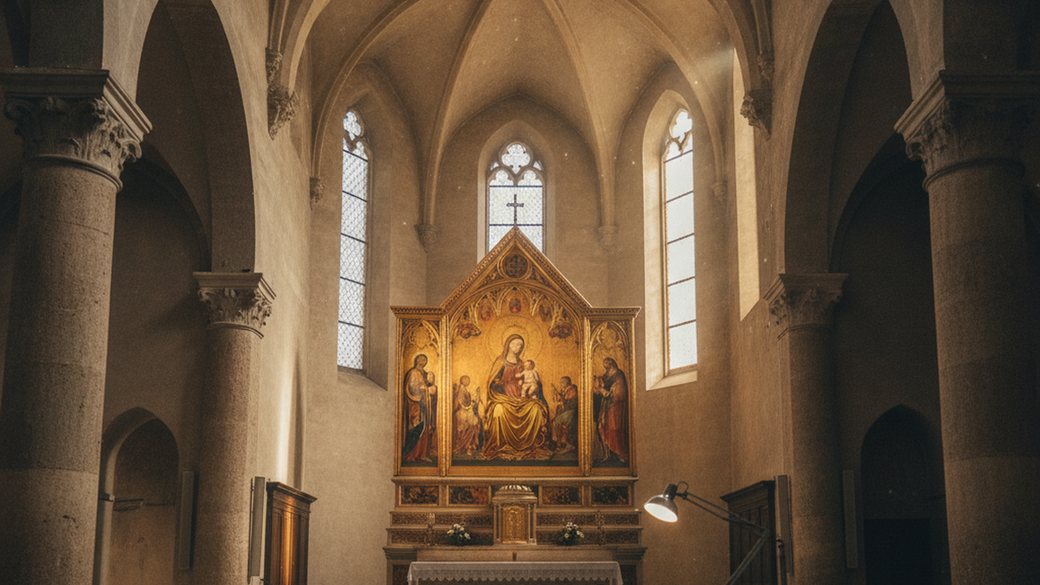
Six hundred years ago a young Dominican friar in the hills above Florence painted a Madonna sitting on a marble throne. Gothic arches rose behind her; there were corbels, and vases of roses, and the whole thing floated on a field of burnished gold. Eighty years later another painter was paid to get rid of all of it. He kept the friar's figures and painted over everything else — the gold, the arches, the throne — replacing them with a soft blue sky and a Tuscan landscape, because that is what a modern altarpiece was supposed to look like in 1501.
This summer the panel came home to Fiesole after two years in a conservation studio, and the story that came home with it is stranger than the usual restoration announcement. The conservators found the throne. Infrared imaging pulled it out of the dark, arch by arch, exactly where the friar had left it. And then they put the picture back on the altar with the throne still hidden, still under the 1501 sky, unrecovered on purpose.
The friar who signed nothing
The painter was Fra Giovanni da Fiesole, remembered as Fra Angelico — the Angelic Friar, a nickname he never used and probably would have found embarrassing. He was a professed Dominican who happened to be one of the great inventors of Quattrocento painting, and the altarpiece he made for his own convent church of San Domenico in Fiesole, around 1420–23, is the earliest of his altarpieces to survive. It was paid for by a rich local merchant, Barnaba degli Agli, whose name-saint Barnabas duly turns up in the picture alongside Thomas Aquinas, Dominic and Peter Martyr, with the Virgin and Child enthroned at the centre and eight angels packed in around them.
What you have to picture, to understand what happened next, is how the thing originally worked. It was not one picture. It was a late Gothic triptych: three compartments divided by carved pilasters, each figure standing in its own gold-lined pocket of space, with a predella — a horizontal strip of small narrative panels — running along the bottom. Gold ground everywhere. It was, in 1423, already faintly old-fashioned, and gloriously so. Gold was not decoration; it was theology, a way of saying that the space behind the Virgin was not a place at all. We wrote about that logic at length in gold in art: the moment painters started putting sky behind their saints instead of gold leaf, something in the medieval settlement quietly ended.
Those predella panels, incidentally, are not in Fiesole. They are in London. Five of them — Christ Glorified in the Court of Heaven and its four wings, dated to about 1423–24 — hang in the National Gallery as NG663.1–5, sawn off and sold in the nineteenth century like so much Italian church furniture. The altarpiece that just returned to Fiesole is a survivor of a dismemberment, not a whole object. That is worth holding onto: nothing about this picture has been left alone.
1501: a modernisation, not a vandalism
By the turn of the sixteenth century the Fiesole altarpiece looked wrong to the people who had to pray in front of it every day. Masaccio had happened. Perspective had happened. Gold grounds now read as archaic, and a triptych's carved dividers read as clutter. So the convent commissioned Lorenzo di Credi — Verrocchio's pupil, Leonardo's studio-mate, a perfectly serious Florentine painter — to bring it up to date.
Di Credi did something surgical. He took out the dividing pilasters and turned the three compartments into one continuous space. He painted out the gold. In its place he gave the Virgin an embroidered canopy of honour, classical architecture, and an opening onto landscape and sky. And then — this is the part that matters — he left Fra Angelico's figures alone. The Madonna, the Child, the saints, the angels: all still the friar's paint, largely untouched, now sitting in a room built for them eighty years after the fact.
It is not a damaged Fra Angelico. It is a collaboration between two painters who never met, one of whom had no say in it.
The instinct of the modern viewer is to call this a desecration. It is worth resisting. Altarpieces were not artworks in our sense; they were functioning liturgical equipment, and updating them was ordinary maintenance, the way a parish rewires a church. Di Credi was not defacing a masterpiece. He was making a devotional object legible to its congregation — and, by the standards of what usually happened to unfashionable panels, he was gentle about it. The same collision between a picture's use and a picture's status runs through almost every rediscovery story we cover, from the overpainted Velázquez to the Rembrandt attributions that turn on what a later hand added.
What the infrared saw
In 2024, with the panel earmarked for a landmark exhibition in Florence, it came down off the altar and went into the studio. The painted surface was taken on by the conservator Daniele Rossi; the warped, ageing wooden support by Roberto Buda. The work was paid for by Friends of Florence, the American non-profit chaired by Simonetta Brandolini d'Adda that has quietly financed a large share of Tuscan conservation over the past two decades, through a group of named donors.
The cleaning itself was the ordinary heroism of the trade: yellowed varnishes lifted, earlier restorers' retouching — the kind that goes brown and starts telling lies about the original colour — taken back off, the gilding recovered, losses filled with watercolour and fine hatching so that every modern mark is reversible and visible up close. On the structural side, degraded butterfly keys were replaced and the panel was given a chestnut support system sprung to move with changes in temperature and humidity, so the wood can breathe instead of splitting.
Then the reflectography. Infrared passes through upper paint layers and reads the carbon underdrawing beneath, and what came up on the screen under di Credi's lapis sky was Fra Angelico's original throne: a stone-coloured marble seat, framed by Gothic arches and corbels, with vases of roses set about it. Conservators noted how close its architectural feeling sits to Masaccio — which, if it holds up, is quietly important, because it puts the young friar in dialogue with the most radical painter in Florence at precisely the moment the two of them were working a few miles apart. The pious miniaturist of legend turns out to have been paying close attention to the avant-garde.
The decision not to strip it
Here is where the story stops being about discovery and starts being about judgement. Having located an original composition by one of the greatest painters of the fifteenth century, the team did not go after it. Di Credi's sky stayed on the panel. The throne stays in the archive, as an image.
You can imagine the counter-argument, and it is not stupid: strip the later paint, recover the Angelico, give the world back a lost Gothic masterpiece. Conservation spent much of the twentieth century doing exactly that, and the results are a mixed inheritance. Stripping is irreversible. Overpaint that has sat for five centuries is bound into the surface below it, and no solvent is clever enough to know where one man's paint ends and another's begins. There is also the harder question, the one restorers argue about at conferences: which painting would you be recovering? The 1423 object no longer exists — its pilasters are gone, its predella is in London, its gold was scraped before di Credi ever touched it. What sits on the altar in Fiesole is a single object with two dates in it, and the honest thing is to conserve what is actually there rather than an idea of what once was.
So the panel now carries its own history on its face: a Gothic altarpiece wearing a Renaissance room, with a marble throne underneath that only a camera can see. The restoration was reported in detail by The Art Newspaper this week, and the fuller conservation account, including the donors and the technical programme, was published by Finestre sull'Arte.
Why it left, and why it went back
The restoration happened because of an exhibition. Beato Angelico, at the Fondazione Palazzo Strozzi and the Museo di San Marco, ran from 26 September 2025 to 25 January 2026 — over 140 works across two venues, curated by Carl Brandon Strehlke with Stefano Casciu and Angelo Tartuferi, with loans from the Louvre, the Met, the Vatican Museums, Berlin, Munich and the Rijksmuseum. It was the first major Florentine show devoted to the artist in seventy years, since the monographic exhibition of 1955.
Big anniversary shows are often written off as museum theatre. This one is a decent argument for them. Without the exhibition there would have been no funding case, no deadline, no reason to take a functioning altarpiece off a working altar — and the throne would still be sitting under the sky, unphotographed. Loan exhibitions are, in practice, how a great deal of conservation actually gets paid for, and how objects that live in parish churches rather than museums finally get looked at with proper instruments.
And then, unusually, it went back. Not to a climate-controlled gallery in Florence with a wall label, but to San Domenico in Fiesole, the church Fra Angelico himself entered as a young man, to hang where it was designed to hang and be seen in the light it was painted for. That return is the whole point. A restored altarpiece in a museum is a specimen. The same panel on its own altar is still doing the job it was made to do — which, for anyone interested in the Renaissance masters as working craftsmen rather than brand names, is worth more than any amount of vitrine.
Honest limits
Two cautions. First, the throne is an infrared reading, not a rediscovered painting — reflectography shows underdrawing and carbon-based layers with real clarity, but it is an interpretation, and how much of that Gothic architecture was fully painted rather than laid in as design is a question the published technical study will have to settle. Second, the Masaccio comparison is a stylistic judgement offered by the people who did the work, not a documented fact; it is suggestive, and it deserves the scrutiny of specialists before it becomes received wisdom. Attribution and dating in this corner of the Quattrocento move slowly and for good reason, as anyone who has followed a long rediscovery case knows.
What is not in doubt is the shape of the thing. A friar painted a throne. A painter of the next century painted a sky over it. Five hundred years later a machine saw the throne through the sky, and a group of people decided, deliberately, to leave both. That is not a failure of nerve. It is the most honest thing you can do with an object that has been alive for six centuries: let it keep all its ages at once. The same argument runs through the restoration of Michelangelo’s Palazzo Farnese cornice, where sixteenth-century lion heads sit beside 1934 replacements and nobody pretends otherwise. The opposite call was made in The Hague in August 2026, when conservators put a deleted soldier back into a Pieter de Hooch courtyard – because that later layer was a market edit, not the object’s own history.
Frequently asked questions
What is the Fiesole altarpiece by Fra Angelico? A Madonna and Child enthroned with eight angels and the saints Thomas Aquinas, Barnabas, Dominic and Peter Martyr, painted around 1420–23 for the Dominican church of San Domenico in Fiesole and commissioned by the merchant Barnaba degli Agli. It is the earliest surviving altarpiece by the artist.
What did the restoration reveal? Infrared reflectography showed Fra Angelico's original setting beneath Lorenzo di Credi's 1501 repainting: a stone-coloured marble throne framed by Gothic arches and corbels, with vases of roses. Conservators Daniele Rossi and Roberto Buda cleaned and stabilised the panel but left di Credi's layer in place, so the throne is visible only in the imaging.
Where can I see it now? After the Beato Angelico exhibition at Palazzo Strozzi and the Museo di San Marco (26 September 2025 – 25 January 2026), the panel returned in 2026 to the church of San Domenico in Fiesole. Five predella panels from the same altarpiece are in the National Gallery, London.