In the autumn of 1621 a young man stepped off a ship into the harbour of Genoa. He was twenty-two, Flemish, already spoken of in Antwerp as the finest of Rubens's assistants, and entirely unknown to the merchant princes whose palaces climbed the hills above him in tiers of painted stucco. Six years later he sailed away as something the art of Europe had not quite seen before: the inventor of a way of painting powerful people that would govern the portrait for the next two hundred years. The city that did this to Anthony van Dyck was not Rome, where he went to study the antique, nor London, where he would end his life as Charles I's knight. It was Genoa — and this summer, for four months, the city finally staged the reckoning.
From 20 March to 19 July 2026, Palazzo Ducale hung the largest Van Dyck exhibition in a quarter of a century, Van Dyck, the European. Over fifty autograph paintings came home to the streets where many were first delivered, borrowed from thirty-two museums across twenty-two cities — the Louvre, the Prado, the National Gallery in London. The show closed a week and a half ago. What it left behind is the question worth asking now that the crowds have gone: why Genoa? What did this specific, secretive, money-drenched republic do to a young painter that Antwerp had not?
A city that dressed in black and thought in silver
To understand Van Dyck's Genoese portraits you have to picture the people who commissioned them. Early-seventeenth-century Genoa was a banking republic at the height of a golden age — il secolo dei genovesi, the century of the Genoese — its great families financing the silver empire of Habsburg Spain and growing colossally rich on the interest. They were not princes with armies. They were bankers with palaces, and they wanted portraits that would do the work of a crown they did not possess: portraits that said authority without ever needing to prove it.
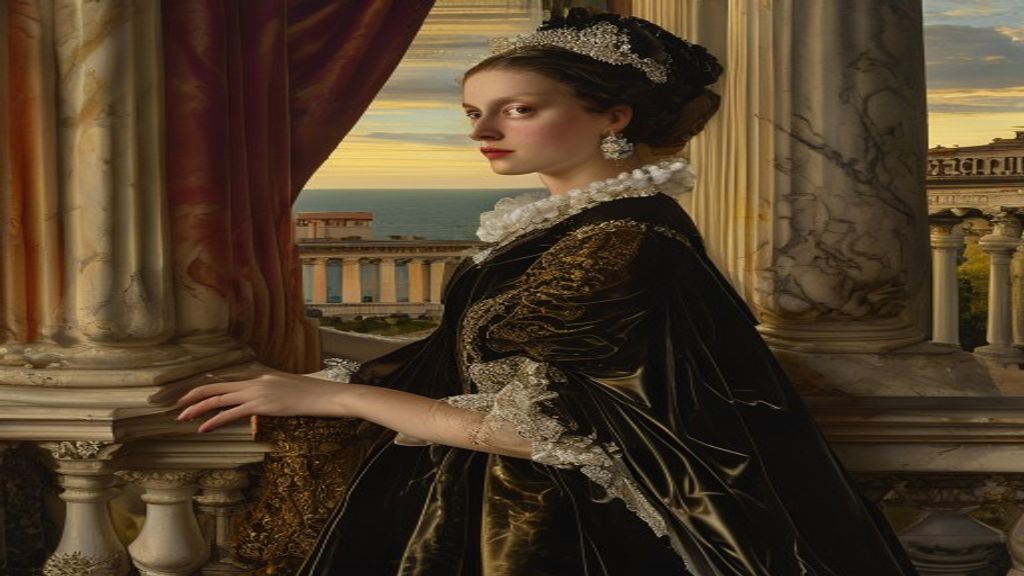
Crucially, the Genoese nobility dressed almost entirely in black. Spanish court fashion and the sober self-image of the merchant patrician meant a wall of dark silk and velvet, relieved only by white lace at the throat and cuffs, a chain of gold, the cold glint of a pearl. For most painters this would be a problem — how do you make black interesting for six feet of canvas? For Van Dyck it became the engine of a style. Against that darkness he learned to make skin luminous, lace crackle with light, and a single crimson curtain detonate like a chord.
They were bankers with palaces, and they wanted portraits that would do the work of a crown they did not possess.
Inventing the grand manner
Rubens had been to Genoa a decade earlier and had even published a book of engravings of its palaces; the ground was prepared. But it was Van Dyck who found the formula. He took the Genoese full-length portrait and stretched it. His sitters grew taller than life, their proportions gently elongated, their heads set slightly small on long bodies so that they seem to tower. He dropped the horizon low, so the viewer looks up. He framed them with the furniture of grandeur — a fluted column, a sweep of red velvet, a distant terrace opening onto a bright Ligurian sky — and then he did the hardest thing of all: he made it look effortless, as though the sitter had simply paused, mid-turn, and would move on the moment you stopped watching.
The results still hang in Genoa. In the Palazzo Rosso, the Marchesa Paolina Adorno Brignole-Sale stands in silver-shot black, aloof and faintly amused; nearby, her husband Anton Giulio rides a horse whose flank fills half the canvas in a portrait of pure equestrian swagger. In Washington, at the National Gallery of Art, the Marchesa Elena Grimaldi Cattaneo walks toward us beneath a vast red parasol held by an African page, her black gown swallowing the light while the sky behind her burns. These are not likenesses. They are arguments about power, and their language was invented in these six years.
The apprenticeship that wasn't
It is easy, looking back, to make Genoa sound like a triumphal procession. It was not. Van Dyck arrived as a prodigy who had never truly been his own master — he had worked inside Rubens's vast studio machine, brilliant but subordinate, one hand among many. Italy was his chance to become a name rather than an assistant, and the risk was real: the peninsula was crowded with painters, the Genoese patrons were demanding and clannish, and a foreigner had to earn every commission twice over.
He also did not stay put. Genoa was a base, not a cage. From it he ranged across Italy — to Rome, where he painted the scarlet portrait of Cardinal Bentivoglio that taught Velázquez and everyone after him how to render a churchman; to Venice, where he steeped himself in Titian's colour and Titian's understanding that paint could behave like flesh; to Palermo, where he was caught in an outbreak of plague. He came back to Genoa changed each time, folding Venetian warmth and Roman gravity into the cool Genoese formula until it became wholly his own. Sorting what a young artist borrows from what he makes is the quiet discipline behind every attribution, the same careful looking that governs how we go about reading a masterpiece centuries later.
What Genoa sent out into the world
When Van Dyck left Italy in 1627 and, a few years on, crossed to London to become principal painter to Charles I, he did not invent a new style for the English court. He exported the Genoese one. The melancholy, silk-clad Stuart aristocrats of his English years — long-fingered, faintly sad, impossibly elegant — are the marchese of Genoa in different weather. And because English portraiture became the fountainhead of a whole tradition, the Genoese formula flowed onward: into Gainsborough and Reynolds in the eighteenth century, into Sargent's swagger portraits at the end of the nineteenth. When a modern eye reads a full-length figure in dark clothes against a column and a curtain as simply, self-evidently "aristocratic," it is reading a sentence Van Dyck first wrote on the hills of Genoa.
That is the real argument of a show like Van Dyck, the European, and its curators Anna Orlando and Katlijne Van der Stighelen built the exhibition around exactly this migration of style across Antwerp, Genoa and London. It is also a reminder of how much a painter's identity is bound up with attribution and provenance — the paper trail of who owned a picture and when — the same forces that determine what a securely named masterpiece is worth today, whether it is a rediscovered Rembrandt pulled out from under later overpaint or a lost Velázquez recovered after four centuries. A name, once attached, is the single most valuable thing a canvas carries.
An honest caveat
It would be neat to say that every full-length in the Genoese palaces is a pure, unaided Van Dyck. It would also be untrue. Like Rubens before him, Van Dyck ran a busy workshop and leaned on assistants for replicas, drapery and lesser passages; the boundary between an autograph portrait, a studio version and a later copy is exactly where scholars still argue, and where technical study — X-rays, infrared, the analysis of underdrawing — keeps shifting the lines. Part of what a landmark exhibition does is precisely this sorting: putting the certain works beside the doubtful ones so that the eye, and the evidence, can do their slow work. Certainty in art history is earned canvas by canvas, and it is never quite finished. That patience is the same one that separates a genuine record-setting attribution from a hopeful guess.
Still, the core of the story is not in doubt. A gifted, unproven young Fleming came to a black-and-silver banking republic on the Ligurian coast, spent six restless years painting its bankers and their wives, and in doing so worked out how to make a mortal look eternal. The palaces he decorated are still there, terracing up the hillside. For four months this year the paintings came back to them. Now the exhibition is over — but the way we picture power, on a wall, in dark silk, against a burning sky, is still his.
Frequently asked questions
How long did Van Dyck live in Genoa? Roughly six years. He arrived in 1621 after leaving Antwerp and left Italy in 1627, using Genoa as a home base while travelling to Rome, Venice and Palermo. It was Genoa's aristocracy that gave him his steadiest run of defining commissions.
Why are Van Dyck's Genoese portraits so famous? Because in Genoa he perfected the full-length grand portrait — elongated figures in black silk against red curtains, columns and low horizons — a formula of effortless authority that shaped European portraiture for two centuries, from Gainsborough and Reynolds to Sargent.
What was the 2026 Palazzo Ducale exhibition? Van Dyck, the European ran at Palazzo Ducale in Genoa from 20 March to 19 July 2026. Curated by Anna Orlando and Katlijne Van der Stighelen, it gathered over 50 autograph paintings from 32 museums and traced his path through Antwerp, Genoa and London.