Rembrandt Rediscovered: The Lost Painting Hidden Under Another Man's Brush
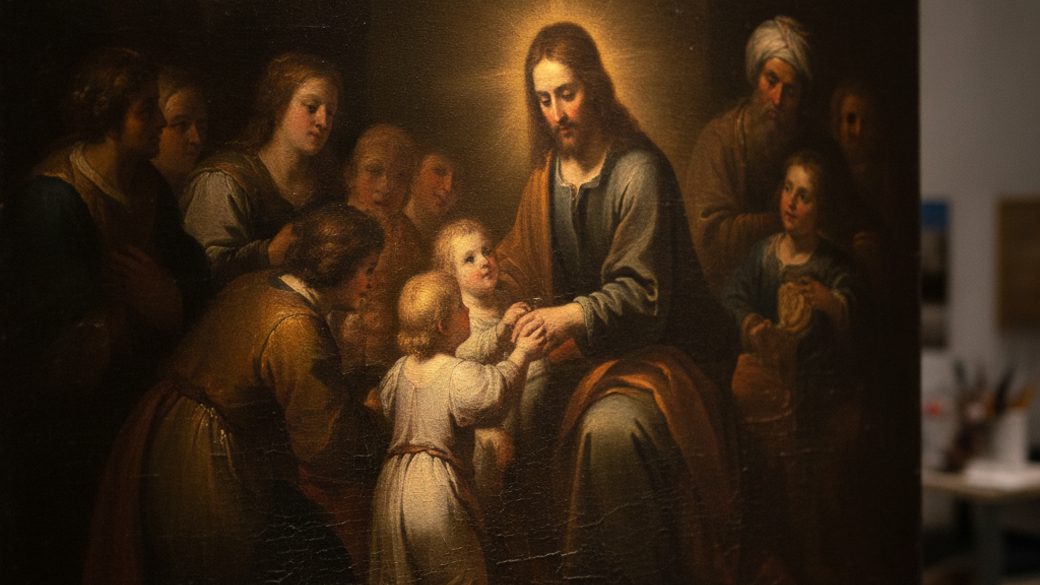
In 2014, in a saleroom in Cologne, a dark and crowded religious picture came up for auction with almost nothing to recommend it. The catalogue at Lempertz listed it as the work of an unnamed seventeenth-century Netherlandish painter — one of those competent, anonymous canvases that pass through the middle of the market every week. It was grimy, heavily varnished, and by most accounts not much to look at. It sold for around €1.5 million: a serious sum for an anonymous Old Master, but a rounding error next to what the picture would eventually mean.
Because sitting in that saleroom, reading that same catalogue, was a man trained to see what almost nobody else could. And what he saw was not an anonymous Dutchman at all. It was a lost Rembrandt — and, buried under a later artist's paint, a figure that someone had gone to the trouble of erasing.
The man who reads catalogues for a living
The dealer was Jan Six — an Amsterdam art dealer who carries one of the most loaded names in the whole of Dutch art. His seventeenth-century ancestor, also Jan Six, was Rembrandt's friend and patron, and the subject of one of the greatest portraits ever painted. To be a Six looking at a possible Rembrandt is to work with the weight of the picture's own history pressing on your shoulder.
Six's eye caught on a detail in the crowd — a face he read as a young Rembrandt self-portrait, the kind of sly authorial cameo the artist liked to tuck into his early religious scenes. That single figure was enough to make him gamble. He acquired the painting for a reported $1.7 million and began the slow, expensive, contested work of proving what he believed: that this crude and darkened canvas was an authentic early work by the greatest of the Dutch masters.
The catalogue said anonymous. The paint said otherwise — if you knew how to read it.
A picture Rembrandt walked away from
The subject is one of the tenderest in the Gospels. In Mark, Matthew and Luke, the disciples try to keep a crowd of children away from Jesus, and he stops them: Let the little children come unto me, and forbid them not. It is a scene about welcome — about who is allowed near, and who is turned away — and that theme turns out to matter enormously to what this particular canvas became.
Scholars now place its beginnings around 1627, when Rembrandt was still a young painter working in his home town of Leiden, sharing ideas and a studio culture with Jan Lievens. It seems he never finished it. When he moved to Amsterdam at the start of the 1630s to become the most sought-after portraitist in the city, this ambitious, complicated crowd scene was apparently left behind, incomplete — a young man's unresolved experiment abandoned for bigger commissions. Rembrandt's early period is exactly where his command of light out of darkness was being forged, the technique we trace in our essay on chiaroscuro and the drama of light.
And here is where the story turns strange. Because a painting Rembrandt left unfinished was, at some later date, finished by somebody else — and that somebody had opinions.
What the later hand tried to hide
When conservators finally stripped away the overpaint, they found that a later, weaker artist had not merely completed Rembrandt's scene but had quietly rewritten it. The changes were not cosmetic. They were, in the fullest sense, editorial.
A bearded man in the crowd, whom the later hand had given a respectable white beard and a soft Dutch cap, turned out in Rembrandt's original to be wearing a turban — an outsider, an Eastern figure, admitted into the sacred circle. The figure of Christ, shown in the finished version resting his hand on an older child's head, had originally been cradling a baby. Detail by detail, the reviser had taken Rembrandt's more mixed, more foreign, more physically intimate crowd and, in the words of the conservators, "sanitised" it into something tamer and more conventionally Dutch. The restoration, reported in detail by Smithsonian magazine, reads almost like an act of censorship performed with a paintbrush.
It is tempting — and not unreasonable — to see the original as an image about tolerance: a Christ who welcomes the turbaned stranger as readily as the local child. But honesty requires a caution here. We cannot interview Rembrandt about his intentions, and the leap from "he painted a turban" to "he was making a deliberate statement about religious inclusion" is interpretation, not proof. The turban is a fact recovered from the paint. Its meaning is a reading — a compelling one, but a reading all the same. Learning to hold that distinction is the whole discipline of reading a masterpiece honestly.
Faces in the crowd
Part of what makes the picture so seductive is the sense that it is populated by real people. The art critic Andrew Graham-Dixon has argued that Rembrandt seeded the crowd with his own circle — that his mother, his father and a godchild are among the faces pressing toward Christ. It is the sort of claim that is almost impossible to prove and irresistible to believe, and it belongs to a long tradition of reading Rembrandt's Leiden pictures as a private family album smuggled into biblical history.
The attribution itself was built slowly and in public rather than proclaimed overnight. The Dutch art historian Christopher Brown included the painting in the landmark Young Rembrandt exhibition at the Ashmolean Museum in Oxford in 2020 — a scholarly stamp that mattered far more than any dealer's enthusiasm. An attribution is never a single moment; it is an accumulation of eyes, and the questions of who decides and how a name gets attached to a canvas are exactly the ones we take up in our piece on provenance and the story behind a painting.
The number, and its honesty
On 1 July 2026, the painting came to Sotheby's in London, the centrepiece of the summer Old Masters evening sale during the city's Classics Week. The estimate was £8–12 million. What happened in the room was quieter than anyone had hoped. The picture sold on a single bid of £8 million — the very bottom of the range — to the third-party guarantor who had effectively underwritten the sale. In market terms, that is a picture that changed hands because someone had already promised to buy it, not because a crowd of collectors fought over it.
It would be easy to read that as an anticlimax, and in the short term it is one. But it is also, in its way, an honest result. A rediscovered early Rembrandt, partly the work of a later hand, its condition complicated by centuries of overpaint and its meaning still under scholarly argument, is a harder thing to sell than a clean, autograph masterpiece. The market, for once, priced the caveats rather than the fantasy. Compare it with the $236 million Klimt portrait sold a few months earlier — a picture with an unbroken chain of ownership and no argument about who held the brush — and the gap tells you exactly what collectors at the top pay for: certainty. The same Classics Week offered a mirror image of that lesson: a flawless bronze copy of the ancient Laocoön sold for £13.6 million — far above any painting in the room. And days later at Christie's, the same hunger set two records for a painter of flowers — Jan van Huysum, whose peaches and grapes made £6.52 million. The same summer offered the opposite case — a picture that gained a name rather than a price, when a lost early Velázquez portrait of the Count-Duke of Olivares resurfaced after four hundred years.
And yet the £8 million is not the real story, any more than the €1.5 million was. The real story is that a picture the whole trade had written off as anonymous carried, all along, both a great artist's abandoned ambition and a later censor's nervous corrections — and that it took one man reading a catalogue, and years of patient conservation, to bring both back to the surface. What Rembrandt left unfinished, someone tried to tidy away. Four hundred years later, the tidying has been undone, and the turbaned stranger is standing in the light again, exactly where the young painter first put him. He is not the only figure to have been tidied away and brought back: at the Mauritshuis, a soldier erased from a De Hooch courtyard was repainted into the picture in August 2026.
Frequently asked questions
What is "Let the Little Children Come unto Me"? It is an early religious painting begun by Rembrandt around 1627 in Leiden, showing Christ blessing a crowd of children — a subject from the Gospels of Mark, Matthew and Luke. Rembrandt seems to have left it unfinished, and a later, lesser hand completed it.
How much did the rediscovered Rembrandt sell for? It sold at Sotheby's in London on 1 July 2026 for £8 million — the bottom of an £8–12 million estimate, on a single bid from the third-party guarantor. The same canvas had sold at Lempertz in Cologne in 2014 for about €1.5 million, catalogued only as an anonymous 17th-century Netherlandish work.
What did the restoration reveal? Stripping the later overpaint uncovered a more diverse original: a man given a white beard and Dutch cap was found wearing a turban, and a Christ shown touching an older child had originally been holding a baby. Conservators concluded a later artist had crudely "sanitised" Rembrandt's scene.