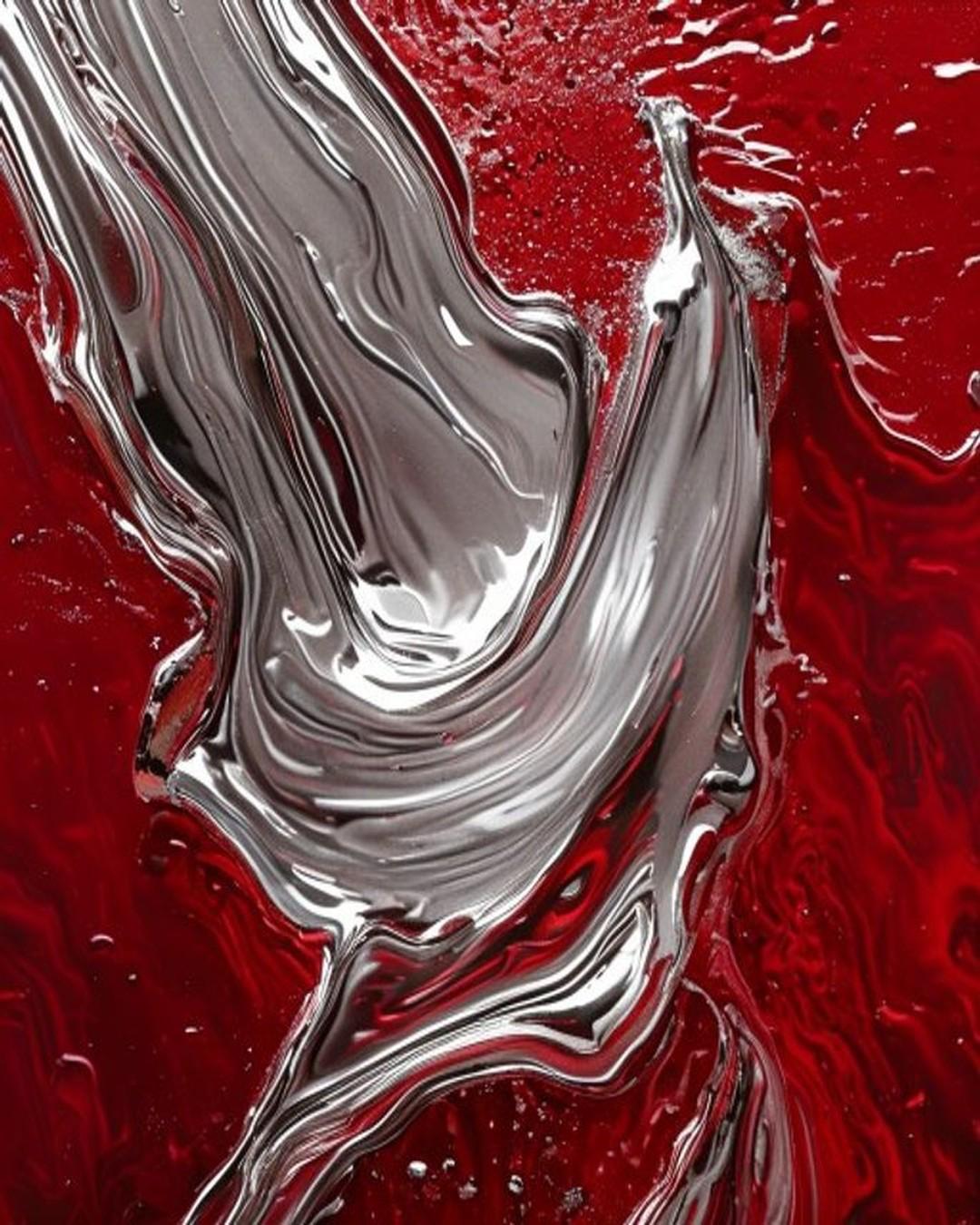
Gold says eternity. Silver and chrome say something stranger: they say you. A truly reflective surface doesn't just sit there being looked at — it looks back, catching the room, the light and the viewer and folding them into the work. That is the quiet trick of every mirror-bright surface in art, from a jewel of paint in a Renaissance portrait to a two-storey sculpture of polished steel. The liquid chrome running through the red above belongs to a fascination six centuries deep.
The mirror inside the painting
Long before artists could make a whole work reflective, they painted reflection as the ultimate flex of skill. In Jan van Eyck's Arnolfini Portrait (1434), a small convex mirror on the back wall reflects the entire room — including two figures standing where we stand, as if we had walked into the scene. Velázquez did something similar in Las Meninas, using a mirror to pull the king and queen into a picture they are not otherwise in. And Parmigianino's Self-Portrait in a Convex Mirror (c. 1524) painted the distortion itself — a swollen hand, a curving room — proving a mirror doesn't just copy the world, it bends it.
A reflective surface is never finished, because it changes every time someone new stands in front of it.
Why metal had to be liquid first
There is a reason chrome and mercury feel so uncanny in art: for most of history, the mirror itself was made of liquid metal. Renaissance mirrors were backed with a tin-mercury amalgam, a shimmering, poisonous silver film — so the very idea of a "mirror" carried a whiff of alchemy and danger. Mercury, the only metal that is liquid at room temperature, became a symbol of everything unstable and transformative. To paint or sculpt a flowing silver surface is to reach straight back into that old magic: metal that moves, that will not hold still, that mirrors and distorts at once.
Koons, Kapoor and the mirror as monument
The twentieth century finally let artists make the whole object reflective. Jeff Koons took childhood kitsch — a twisted balloon animal — and cast it in mirror-polished stainless steel the size of a car. His Balloon Dog (Orange) sold for 58.4 million dollars in 2013, at the time a record for a living artist, and its magic is entirely in the surface: you cannot photograph it without photographing yourself.
Anish Kapoor pushed the idea to civic scale with Cloud Gate in Chicago — the mirror-polished "Bean" that swallows the whole skyline and every tourist beneath it into one seamless silver curve. In both cases the reflective metal does the same thing the red does in the image above: it refuses to be a passive object. It reaches out, grabs its surroundings, and makes them part of itself.
Silver's honest flaw
There is one more reason chrome and silver feel different from gold. Gold never tarnishes; silver does. Left alone, real silver leaf darkens and clouds — which is precisely why so many artists, from the old gilders to today, prefer the look of liquid metal rendered in paint, lacquer or steel over the fragile real thing. The chrome in a contemporary work like this one is an illusion of mercury that will never oxidise: all of silver's cold, mirror-bright drama, with none of its decay. Set that restless silver against a field of deep, arterial red and you get the whole appeal of the material in a single image — something molten, reflective and alive, caught for a moment before it can flow away.