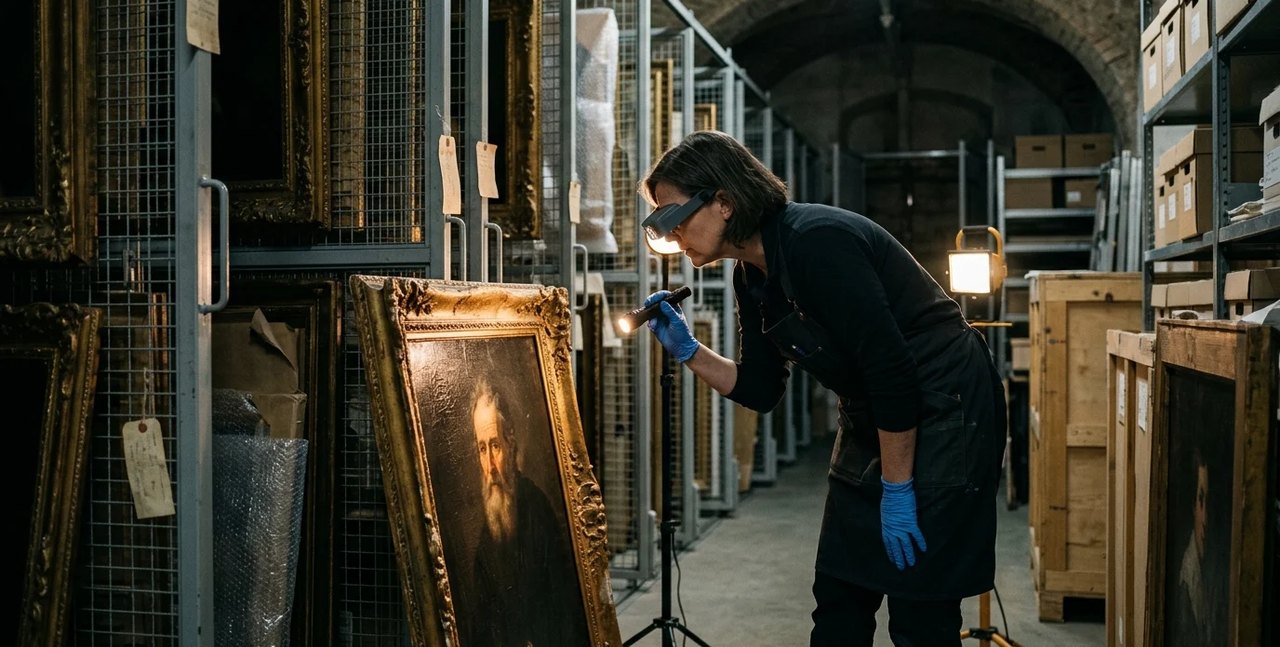
Every great museum has rooms the public never enters. Not vaults exactly — working rooms, with sliding steel racks and strip lighting and a smell of dust and linseed, where the pictures that nobody has asked about in a generation hang in rows like coats in a cloakroom. The Kunsthistorisches Museum in Vienna has such rooms, and in one of them, for the better part of a century, hung a near life-size canvas of an old man with wild white hair, a white collar, and a black garment going soft in the shadows.
Nobody had much to say about him. The museum had tried, over the decades, to work out who painted him, and the results read less like scholarship than like a list of suspects. He has been a Philippe de Champaigne. He has been an anonymous Roman. He has been a Jean Jouvenet, a Jakob Ferdinand Voet, an Erasmus Quellinus the Younger, a Baciccio. Six names, roughly, in a hundred years — each one written down with confidence, each one quietly withdrawn.
In August 2026 the museum proposed a seventh. The curator Gudrun Swoboda believes the head was painted by Gian Lorenzo Bernini: the man who carved the Apollo and Daphne, who designed the colonnade that holds St Peter's Square in its arms, who was by common consent the greatest sculptor in Europe for most of the seventeenth century. If she is right, this is not merely one more picture added to a catalogue. It is a correction to what we thought Bernini was doing with the last decade of his life.
A hundred years of wrong labels
The canvas arrived in Vienna by the ordinary route. The collector Richard Lieben bought it in 1900 — before that the trail runs back through a Baron Engelshofen and then goes cold — and it entered the Kunsthistorisches Museum in 1920 as a work by Philippe de Champaigne, the Paris portraitist of Richelieu and the Jansenists. That attribution did not hold. Neither did the next, nor the one after.
The list is more revealing than any single name on it. De Champaigne is French and severe; Jouvenet, French and a generation later. Voet was a Flemish portraitist working in Rome, Quellinus an Antwerp man in the orbit of Rubens, Baciccio Bernini's own protégé and the painter of the ceiling of the Gesù. These are not random guesses. They are the guesses of people who could see that the picture was good, that it came from somewhere in the Roman-Flemish-French tangle of the later 1600s, and who could not find the hand.
The picture was never lost. It was simply never looked at by the right person, in the right week, with the right question in mind.
This is how most rediscoveries actually happen, and it is worth saying plainly because the headlines always suggest otherwise. There is rarely an attic. There is usually a store, a catalogue entry, and a label that everyone has stopped reading. We have written about the same pattern when a Rembrandt surfaced with a turban painted out beneath the varnish, and when a Velázquez portrait of Olivares came back into focus. The object does not change. The attention does.
The painter nobody can find
Here is the strange fact that gives this story its weight. Bernini painted — constantly, apparently, and well. His biographer Filippo Baldinucci, writing in 1682, two years after the sculptor's death, put the number at more than 150 pictures, made largely for his own pleasure. Bernini's son Domenico, writing in 1713, raised it to around 200.
And of that output, specialists today accept roughly sixteen paintings. Fewer than twenty on the most generous count. The best known are the two self-portraits in the Galleria Borghese in Rome — the young man with the startled, hungry eyes, and the mature man who has clearly stopped being surprised by anything. Almost every accepted canvas falls between about 1620 and 1640, when Bernini was in his twenties and thirties. After that the painted record essentially stops, with a single accepted exception around 1666.
So somewhere between 130 and 180 paintings by the most famous artist in Europe have gone missing. Not destroyed, necessarily. Missing in the way this Vienna canvas was missing: hanging on a wall, catalogued, insured, and filed under somebody else's name. Every curator who works on Bernini knows this arithmetic, and it is the reason a storeroom in Vienna is a plausible place to find him.
What the curator saw in the mouth
Swoboda's argument is stylistic, and it is specific. The face, she observes, is not drawn and then coloured; it is built. The anatomy comes up out of the canvas in short, dense strokes, the musculature of the cheeks and the corners of the mouth massed and modelled rather than described — an approach, as she puts it, almost more sculptural than pictorial. It is the method of a man whose first instinct, confronted with a face, was to add clay to it.
From there she goes to the comparisons. The mouth, and particularly the way its corners are cut and turned, is set beside the marble bust of Louis XIV that Bernini carved in 1665 and that still sits at Versailles — the one piece of real sculpture to come out of his disastrous, celebrated trip to Paris. The inclination of the head, the fall of light, the collar and the gaze are set beside Bernini's late self-portrait drawing in the Royal Collection, dated to about 1675–80. On the costume evidence — the collar, the cut, the hair — Swoboda dates the painting to around 1670.
Technical examination added something the eye alone would have argued about: the canvas was worked by two different hands. The head and the collar are of a conspicuously higher quality than the black garment and the right shoulder, which are flatter and duller. The reading offered is a familiar one for a busy seventeenth-century studio — the master took the face, and the drapery went to an assistant, possibly one of Bernini's own sons.
The problem with 1670
An honest account has to put the difficulties next to the evidence, and there are several.
The first is the date. If the picture is from around 1670, it sits thirty years outside the accepted corpus. Bernini would have been about seventy-one, deep in the work of the Ponte Sant'Angelo angels and the tomb of Alexander VII, and painting — on the current evidence — almost not at all. That is not an argument against the attribution; the whole point of Baldinucci's 150 is that the surviving sixteen are a bad sample. But it does mean the picture is being compared with works made by a much younger man, which is the weakest ground on which connoisseurship ever has to stand.
The second is the sitter. Swoboda has suggested Mario Chigi, brother of Pope Alexander VII and one of Bernini's significant late patrons. It is a reasonable proposal for an old Roman gentleman painted by Bernini in his last years. It also has a wrinkle worth stating: Mario Chigi was born in 1594 and died in 1669. A portrait dated to around 1670 would therefore be a very late likeness, a posthumous one, or a sign that the costume dating needs a year or two of slack. None of those is impossible. All of them need explaining.
The third is the silence of the archive. Nothing published so far connects this canvas to Bernini by name — no contract, no letter, no inventory entry, no early copy or engraving. The provenance simply stops in 1900. For an artist as relentlessly documented as Bernini, whose daily movements in Paris were written down by a hostile French courtier, that absence is not fatal but it is loud.
Which is to say: this is an attribution, not a proof. It is a trained eye making an argument in public, where other trained eyes can disagree with it — and in the Bernini literature, they will. The scientific tools that now accompany these cases can tell you a great deal about materials, layers and hands, as we found when looking at how machine analysis performs on a disputed Caravaggio, but they cannot sign a painting. The final step is still a judgement, made by a person, with a name on it. The same test is now running in Spain, where a small devotional canvas sold as a Francisco Bayeu is being reattributed to Goya on the strength of expert eyes alone, with the laboratory work still to come.
Why a storeroom picture matters
If the attribution holds, the gain is not really one painting. It is a door into the last act of Bernini's life. A late portrait would mean that the man who had stopped painting never actually stopped — that between the commissions and the scaffolding and the papal politics he was still, in his seventies, putting a face together in oil the way he put one together in clay. It would also give scholars something they have badly lacked: a dated point of comparison at the far end of a career, against which other anonymous Roman heads in other storerooms can finally be measured. One secure late work tends to produce others.
And if it does not hold — if the specialists arrive in December and conclude that this is a very good Roman portrait by somebody else — the picture will have been worth the trouble anyway. It will have been examined, published and argued over, which is more than it received in the hundred years when everyone agreed it was a de Champaigne and left it on the rack. Who made a thing, and how it came to be here, is not museum housekeeping; it is the whole discipline, as we have argued in our piece on provenance and the story behind a painting.
The canvas goes on public view on 2 December 2026, in Bernini, Painter and Sculptor at the Palais Lobkowitz in Vienna, alongside around ten international loans, and runs until 4 April 2027. The old man will be hung at eye level, lit properly, with a label that finally proposes a name worth arguing about. He has waited a hundred years in a room with no visitors for the privilege.
Frequently asked questions
Which Bernini painting was rediscovered in Vienna? A near life-size canvas known as Portrait of an Old Man, held by the Kunsthistorisches Museum since 1920 and long kept in storage. Curator Gudrun Swoboda has attributed it to Gian Lorenzo Bernini and dated it to around 1670. It goes on view at the Palais Lobkowitz from 2 December 2026 to 4 April 2027.
How many paintings by Bernini survive? Roughly sixteen are widely accepted, fewer than twenty on the broadest count, and almost all of them date from about 1620 to 1640. Baldinucci put his output at more than 150 pictures in 1682; his son Domenico said around 200. The great majority is lost or unrecognised.
How was the painting attributed to Bernini? Stylistically, not documentarily: the sculptural build-up of the face in short dense strokes, comparisons with the 1665 Louis XIV bust at Versailles and with Bernini's late self-portrait drawing in the Royal Collection, plus technical evidence of two hands on the canvas. No document naming Bernini has been published.